

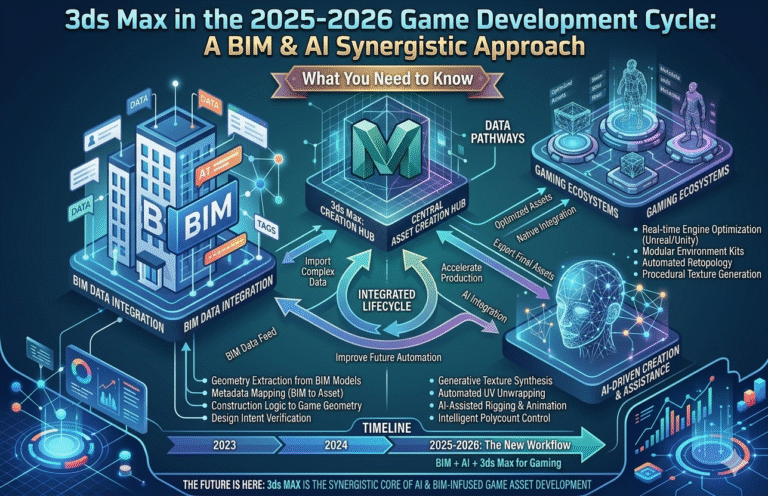
In the rapidly converging worlds of BIM, AI, and gaming, 3ds Max continues to stand as a cornerstone tool for 3D visualizers and game artists seeking photorealistic rendering, animation, and high-fidelity asset creation. The persistent question — can 3ds Max be used for game asset development 2026? — receives a definitive yes from industry professionals who leverage its advanced modifier stack, AI-powered modeling enhancements, and tight integration with real-time engines like Unreal Engine 5.
Historically dominant in architectural visualization and product rendering within the AEC sector, 3ds Max has evolved into a preferred pipeline for creating optimized, game-ready characters, environments, props, and VFX elements. Its ability to handle complex geometry, procedural scattering, and photoreal materials makes it ideal for bridging detailed BIM models (often originating in Revit or Rhino) into interactive gaming experiences, virtual production sets, and metaverse environments. With the 2026 release introducing significant performance improvements, smarter retopology, OpenPBR material standards, and enhanced USD/Datasmith support, 3ds Max 2026 new features for game artists directly address longstanding pain points: slow viewport performance in dense scenes, time-consuming manual topology cleanup, and inconsistent material translation across pipelines.
Authoritative sources consistently affirm its continued relevance. Autodesk’s official 3ds Max 2026 release documentation emphasizes 15–40% faster modifier operations (Boolean, Conform, Array), AI-assisted edge flow in Smart Polygon Modeling, and native OpenPBR support for PBR-compliant game exports [Autodesk]. Industry analyses from CG Channel and 80.lv highlight its strength in professional game asset pipelines, particularly when paired with Substance Painter and Unreal Engine 5 [CG Channel; 80.lv]. Community discussions on ArtStation Learning and Reddit’s r/gamedev threads confirm studios still rely on 3ds Max for AAA-quality assets due to its modifier non-destructive workflow and plugin ecosystem (V-Ray, Forest Pack, RailClone) [Reddit]. Even Epic Games maintains active Datasmith exporter support for 3ds Max 2026, enabling seamless scene transfer with hierarchy, materials, and lights preserved [Epic Games]. These endorsements debunk outdated myths that 3ds Max is dead for game development.
As AI continues to reshape creative workflows—automating retopology, optimizing polycounts, and accelerating iteration—3ds Max positions itself as a premium, production-proven choice for game artists who demand reliability, precision, and integration with real-time engines. This in-depth guide explores modern workflows, comparisons, myth-busting, and future-proof features to help professionals decide if 3ds Max fits their 2026 game development pipeline. For expert training, explore our 3ds Max courses in Dubai.
3ds Max has long been the preferred platform for 3D visualizers creating photorealistic architectural renders and animations. Its transition into game asset development leverages the same core strengths—parametric modifiers, procedural tools, and high-quality rendering—that make it excel in BIM visualization. Today, game artists use 3ds Max to convert detailed facility models into interactive game levels, VR experiences, and cinematic sequences, solving common pain points such as topology issues during high-to-low poly conversion, inconsistent PBR material translation, and performance degradation in complex scenes.
The 2026 version accelerates this crossover with multithreaded Boolean operations (up to 40% faster), AI-driven polygon optimization, and native USD Layer support for managing asset variants. These improvements directly benefit artists working on open-world environments, modular asset kits, and character pipelines where speed and quality are non-negotiable.
| Era | Key Advancement | Impact on Game Asset Creation |
|---|---|---|
| Pre-2020 | Modifier Stack & RailClone | Procedural modular environments |
| 2020–2024 | Datasmith & Retopology Tools | Direct BIM-to-game pipeline |
| 2025 | AI Retopology & Substance 3.0 | Automated high-to-low conversion |
| 2026 | OpenPBR, USD Layers, AI Optimization | Engine-native PBR & variant control |
This evolution cements 3ds Max as a bridge between detailed BIM visualization and high-performance gaming pipelines.
The 3ds Max 2026 new features for game artists focus on performance, automation, and interoperability—directly tackling bottlenecks in asset production such as slow retopology, viewport lag with millions of polygons, and material mismatches during engine import. Key highlights include ReForm retopology speed improvements, Flow Retopology cloud processing (50 jobs/month), OpenPBR as default material, and significant Boolean/Array performance gains.
AI-powered Smart Polygon Modeling suggests clean edge flow automatically, while Asset Optimization Intelligence reduces polycounts intelligently without sacrificing silhouette quality—essential for mobile and console targets. Arnold’s GPU Toon shading and neural denoising further accelerate stylized and photoreal previews.
| Feature | Benefit for Game Artists | Estimated Time Savings |
|---|---|---|
| Retopology Tools | Quad-based clean meshes from high-poly | 50–70% |
| Boolean Performance | Rapid modular kit creation | 40% |
| AI Polygon Optimization | Automatic polycount & UV reduction | 2–3× faster |
| Direct UE5 Bridge | Live iterative updates | Hours per day |
These updates make 3ds Max 2026 one of the most production-ready tools for modern game asset creation.
The game ready asset workflow 3ds Max 2026 follows a streamlined high-poly → retopology → UV → baking → texturing → rigging → export sequence, now supercharged by AI assistance and performance enhancements. Artists start with high-detail sculpts (ZBrush/Mudbox), apply Smart Polygon for base cleanup, retopologize with ReForm/Flow, optimize UVs, bake maps, texture in Substance Painter, rig with CAT/Biped, and export FBX or USD with LODs and animations.
2026 enhancements reduce manual steps dramatically: AI edge flow suggestions, faster Displacement baking, Vertex Weld spline support, and OpenPBR setup ensure clean engine handoff.
| Stage | Primary 3ds Max 2026 Tool | Typical Output |
|---|---|---|
| Modeling | Retopology + AI Smart Polygon | Optimized base mesh |
| Texturing | Substance Live Link + OpenPBR | 2K/4K PBR texture set |
| Export | FBX / USD Exporter | Engine-ready asset package |
This workflow delivers production-grade assets in significantly less time than legacy methods.
The Unreal Engine 5 and 3ds Max 2026 workflow leverages the maintained Datasmith exporter (supported through 2026) and the Direct Link Bridge for near real-time iteration. Artists model in 3ds Max, assign OpenPBR materials, organize layers, export as .udatasmith, and import directly into UE5 where Nanite, Lumen, and virtual shadows are applied automatically.
Live updates via Bridge allow changes in Max to propagate instantly to the engine, dramatically reducing round-trip time for lighting, material, and geometry tweaks.
| Asset Category | Export Format | UE5 Automatic Feature |
|---|---|---|
| Large Environments | Datasmith | Nanite + Lumen |
| Characters | FBX + USD | Skeletal Mesh + Animation |
| Modular Props | USD Layers | Variant Switching |
This pipeline minimizes friction for game artists working in mixed BIM-gaming projects.
The 3ds Max vs Blender for game assets 2026 debate centers on professional reliability versus accessibility. 3ds Max offers unmatched modifier depth, enterprise plugin support (V-Ray, Forest Pack), native Datasmith for UE5, and AI-assisted topology tools. Blender counters with zero cost, Geometry Nodes proceduralism, powerful sculpting, and an explosive addon ecosystem.
For studio pipelines requiring consistency, version control, and direct engine bridging, 3ds Max remains the professional choice in 2026.
| Criteria | 3ds Max 2026 | Blender 4.x |
|---|---|---|
| Cost | Subscription | Free |
| Retopology | AI ReForm + Flow | Addons + Manual |
| UE5 Integration | Datasmith + Bridge | FBX (limited) |
| Large Scene Performance | Excellent | Good (improving) |
3ds Max holds the edge for professional, pipeline-driven game asset work.
Is 3ds Max dead for game development? Absolutely not. While Blender’s rise among indie developers created this perception, major studios and AAA pipelines continue to rely on 3ds Max for its stability, modifier system, plugin ecosystem, and direct Unreal Engine integration. The 2026 release with AI modeling tools, performance uplifts, and maintained Datasmith support proves ongoing investment.
Professionals value its ability to handle complex topology, VFX integration, and seamless Substance/Arnold workflows—areas where many free tools still lag in production reliability.
| Common Myth | Current Reality (2026) |
|---|---|
| Blender replaced 3ds Max | Many pros use both; 3ds Max dominates pipelines |
| No meaningful updates | AI, performance, USD, OpenPBR added |
| Too expensive for games | ROI from speed and reliability in pro studios |
The software is very much alive and evolving for game development.
The best 3d modeling software for games 2026 list is led by tools offering speed, reliability, and engine integration. Unreal Engine 5’s built-in modeling, Blender’s free accessibility, Maya’s animation strength, and 3ds Max’s asset creation precision typically rank at the top. 3ds Max consistently places in the top 3 for professional game asset work due to its modifier system, AI tools, and Datasmith pipeline.
For studios prioritizing consistency, plugin depth, and direct Unreal integration, 3ds Max remains a premium choice in 2026.
| Rank | Software | Primary Strength in 2026 |
|---|---|---|
| 1 | Blender | Free + extremely versatile |
| 2 | 3ds Max | Professional asset pipelines & UE5 integration |
| 3 | Maya | Character rigging & animation |
| 4 | Unreal Engine 5 | Native in-engine modeling |
3ds Max remains a top-tier choice for serious game asset production.
3ds Max is not only viable but exceptionally well-suited for game asset development in 2026. With powerful AI-assisted modeling, significant performance improvements, OpenPBR standardization, and continued Unreal Engine 5 integration, it bridges the gap between detailed BIM visualization and high-performance gaming pipelines. Whether you’re creating photoreal environments, optimized characters, or cinematic sequences, 3ds Max delivers the precision, flexibility, and speed professionals demand.
Ready to master these modern workflows? Explore expert-led 3ds Max training in Dubai at Orbit Training and elevate your game art and visualization skills for 2026 and beyond.