Our 3D Printing Course combines hands-on projects with expert instruction, helping you build real, job-ready skills in Dubai.
Join our 3D printing course in Dubai, available in-person and online. Learn to design, slice, and print functional 3D objects using industry-standard tools — from Tinkercad and Fusion 360 to FDM and resin printer operation. Suitable for beginners, engineers, architects, product designers, and students. Gain 3D printing certification aligned with Dubai’s 2030 additive industry.







3D printing training at Orbit Training Centre teaches you to design, prepare, and produce physical objects from digital models using additive manufacturing technology. Under the guidance of Karthikayan Balamurugan — 15 years of training experience, 2,000+ professionals trained — you work through hands-on sessions covering 3D design using Tinkercad and Fusion 360, slicing software configuration using Cura, FDM and resin printer operation, support structure design, post-processing, and print quality troubleshooting. Certification is internationally recognised and aligned with UAE employer and industry requirements.
3D printing training at Orbit Training Centre teaches you to design, prepare, and produce physical objects from digital models using additive manufacturing technology. Under the guidance of Karthikayan Balamurugan — 15 years of training experience, 2,000+ professionals trained — you work through hands-on sessions covering 3D design using Tinkercad and Fusion 360, slicing software configuration using Cura, FDM and resin printer operation, support structure design, post-processing, and print quality troubleshooting. Certification is internationally recognised and aligned with UAE employer and industry requirements.
The course runs across 30 to 35 hours of 2-hour sessions, delivered in small batches or one-to-one for professionals with specific project needs. You produce a portfolio of printed objects — from a product prototype to an architectural component — that demonstrates operational and design competency to Dubai employers, clients, and fabrication studios actively hiring 3D printing specialists under the city’s 2030 technology mandate.
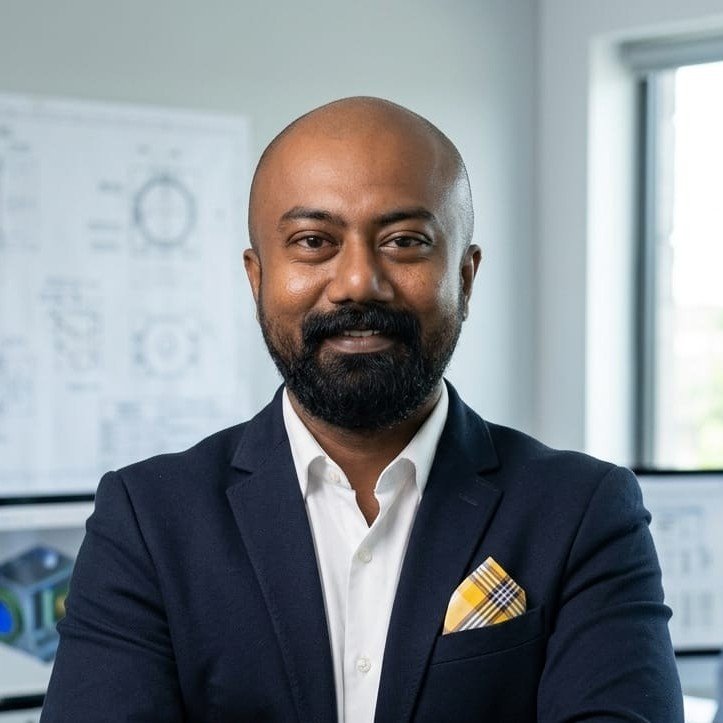
Karthikayan B is a seasoned professional with over 10 years of experience in CAD engineering, 3D modeling, visualization, corporate training, and project management. Starting his career in 2011 as a CAD Draftsman, he has progressed through various roles involving site design, 3D visualization, and advanced training delivery.
As a skilled communicator and corporate trainer, he excels in delivering training on IT-related products, Autodesk AEC/M&E solutions, and design software. He has successfully trained professionals at institutions and corporations across the globe, including Ghana, Oman, Sri Lanka, Malaysia, Bangladesh, and multiple cities in India.
His expertise in business profit maneuvering is reflected through revenue generation, operational management, and curriculum development in diverse international locations. Karthikayan has conducted numerous workshops and corporate training programs, helping professionals enhance their skills in advanced design and visualization tools.
Flexible and analytical with a keen eye for detail, he is passionate about 3D modeling, visualization, and training, with a strong appetite for adopting new technologies. His extensive international exposure and hands-on experience enable him to approach training with seriousness, diligence, and a clear focus on real-world industry applications.
| Day | Timing | Classes Type | Class Hour’s |
|---|---|---|---|
| Monday | 10:00 AM – 09:00 PM | Batches | 2 Hours Session |
| Wednesday | 12:00 PM – 09:00 PM | One to one | 2 Hours Session |
| Thursday | 10:00 AM – 09:00 PM | One to one | 2 Hours Session |
| Friday | 12:00 PM – 09:00 PM | Private | 2 Hours Session |
| Saturday | 10:00 AM – 09:00 PM | Batches | 2 Hours Session |
| Sunday | 10:00 AM – 09:00 PM | One to one | 2 Hours Session |
3D printing, also known as additive manufacturing, is the process of creating physical three-dimensional objects from a digital design file by depositing material layer by layer — rather than cutting or moulding from a block. The technology spans FDM (Fused Deposition Modelling) using plastic filament, SLA and MSLA resin printing for high-detail objects, and large-scale concrete extrusion for construction. In Dubai, 3D printing is not an emerging trend — it is a stated government priority. The Dubai 3D Printing Strategy, launched by HH Sheikh Mohammed in 2016, mandates that 25% of all new buildings in Dubai be constructed using 3D printing technology by 2030 (UAE Government Portal). The UAE 3D printing construction market is projected to grow from USD 78.84 million in 2024 to USD 881.75 million by 2032 — a CAGR of 35.23% (Markets and Data, 2025). 3D printing course training at Orbit prepares professionals to work in this mandated, fast-scaling sector.
Dubai’s 3D Printing Strategy is government policy. Dubai Municipality’s 3D printing licensing framework already governs building construction using additive methods. In May 2024, Dubai began construction of the world’s first 3D-printed mosque — a 2,000 square metre structure designed to accommodate 600 people.
The Dubai Health Authority set a target of AED 1.7 billion in 3D-printed medical product value by 2025, covering prosthetics, dental implants, surgical guides, and orthopaedic devices.
Members of Dubai’s 3D Printing Strategic Alliance include Dubai Municipality, Dubai Health Authority, DEWA, RTA, and Khalifa University. Construction, healthcare, aerospace, defence, consumer goods, and education sectors across the UAE are hiring professionals who can design, operate, and troubleshoot 3D printing workflows.
A 3D printing technician or additive manufacturing specialist in Dubai earns AED 5,000–12,000 per month, rising to AED 12,000–20,000 for engineers with design and production system experience.
This 3D printing design course runs across 35 hours of 2-hour sessions. You will learn to:
You will print a minimum of five objects, including an architectural scale component and a product prototype, and learn to diagnose common print failures.
This course is open to anyone — no CAD or engineering background is required to start.
Absolute beginners start in Tinkercad (browser-based). Engineers and architects who already use AutoCAD, Revit, or SolidWorks can jump to Fusion 360 or slicing stages. Product designers, medical device technicians, jewellery makers, and educators working in STEM programs enroll to add hands-on additive manufacturing skills.
Students from Grade 9 upward and corporate teams from construction, healthcare, and manufacturing also join. Both in-person and online 3D printing classes are available with the same curriculum and trainer.
| Job Title | Sector | AED Monthly Salary Range |
|---|---|---|
| 3D Printing Technician | Construction / Fabrication Studio | AED 5,000–8,000 |
| Additive Manufacturing Specialist | Industrial / Manufacturing | AED 7,000–12,000 |
| Product Design Engineer (3D Printing) | Product / Consumer Goods | AED 8,000–15,000 |
| 3D Design Engineer (Architecture) | Construction / Real Estate | AED 8,000–14,000 |
| Medical 3D Printing Technician | Healthcare / DHA Facilities | AED 6,000–12,000 |
| Freelance 3D Printing Designer | Multi-sector, project-based | AED 5,000–18,000 |
Dubai’s 3D printing construction market is projected to reach USD 881 million by 2032. Companies like 3DVinci Creations, 3DXB Group, Printstone3D, and Immensa hire 3D printing professionals on a rolling basis. Freelance 3D printing designers serve architecture studios, dental clinics, jewellery brands, and product companies.
Karthikayan Balamurugan, CAD and software trainer with 15 years of UAE training experience, has trained over 2,000 professionals at Orbit Training Centre across technical design, CAD, and software disciplines.
Orbit’s 3D printing course is one of the only KHDA-aligned 3D printing certification programs in Dubai.
The free demo session puts a 3D printer in front of you on day one. You watch a live FDM print in progress, design a simple object in Tinkercad, and export a sliced G-code file — all before committing to enrolment.
One-to-one training allows engineers who need only slicing and printer calibration to focus exactly on those skills. Post-training support includes 30-day access to materials, direct trainer queries on specific print problems, and guidance on certification assessment.
Online 3D printing classes use live sessions with the same trainer, curriculum, and project exercises as the in-person format.
| Skill Learned | Tool / Technology | Job Title in Dubai | AED Monthly Salary |
|---|---|---|---|
| 3D Design + Slicing | Fusion 360 + Cura | 3D Design Engineer | AED 8,000–15,000 |
| FDM + Resin Operation | Creality / Anycubic printers | 3D Printing Technician | AED 5,000–8,000 |
| Product Prototyping | Tinkercad + Fusion 360 | Product Designer (3D) | AED 8,000–15,000 |
| Architectural 3D Printing | Scale model production | Architectural Model Maker | AED 6,000–12,000 |
| Medical Device Printing | High-precision resin | Medical 3D Printing Tech | AED 6,000–12,000 |
3D printing, also called additive manufacturing, is the process of building a physical, three-dimensional object by depositing or curing material layer by layer, based on a digital 3D design file, rather than cutting or shaping material away from a solid block as traditional manufacturing does. The two most common consumer and professional-grade technologies are FDM (Fused Deposition Modelling), which extrudes melted plastic filament through a heated nozzle to build up an object layer by layer, and resin printing (SLA/DLP), which cures liquid photopolymer resin with UV light for much higher surface detail. Both start from the same place: a digital 3D model, either designed from scratch in CAD software or scanned from an existing physical object, which is then “sliced” by software into hundreds or thousands of thin horizontal layers that the printer builds sequentially. What makes 3D printing significant for industries like construction, healthcare, and product design is that it removes many of the constraints of traditional manufacturing — complex geometries that would be impossible or extremely expensive to machine conventionally can often be 3D printed directly, and small production runs or one-off custom parts become economically viable in a way they weren’t with tooling-dependent traditional manufacturing.
In construction, 3D printing is used to produce building components and, increasingly in Dubai specifically, entire structures — Dubai began construction of the world’s first 3D-printed mosque in 2024, a 2,000 square metre structure designed to accommodate 600 people, reflecting how far beyond novelty prototyping this application has moved locally. In healthcare, 3D printing produces dental implants, surgical guides, prosthetics, and orthopaedic devices with a level of patient-specific customisation traditional manufacturing can’t match cost-effectively — the Dubai Health Authority has set explicit targets for 3D-printed medical product value, underlining how seriously the sector is investing here. In product design and manufacturing, 3D printing is the standard tool for rapid prototyping, letting designers test and iterate a physical product multiple times in the period it would take to produce a single traditionally-tooled prototype. In architecture, 3D printing produces detailed scale models for design presentation and client sales far faster and often more accurately than traditional hand-built models. Jewellery designers use high-precision resin printing to prototype intricate designs before casting in precious metals, and educators use 3D printing as a hands-on teaching tool across STEM curricula.
The course runs across 35 hours of 2-hour sessions and moves progressively from design fundamentals through to independent print production. You’ll start in Tinkercad, designing functional objects from scratch in a browser-based environment built for beginners, before moving into Fusion 360 for parametric modelling — working with defined tolerances, fillets, and chamfers the way a professional product or mechanical designer would, rather than freehand shape-building. From there, you’ll learn to export print-ready STL files and slice models in Cura, understanding how layer height, infill percentage, and support structure settings affect both print quality and print time — decisions that matter enormously for anyone producing production-quality output rather than rough prototypes. The hands-on printing component covers operating FDM printers, including bed levelling and first-layer calibration (the single most common source of failed prints), alongside resin printer UV curing and washing protocols for higher-detail work. You’ll print a minimum of five objects across the course, including an architectural scale component and a product prototype, and you’ll learn to diagnose the common print failures — warping, layer separation, stringing, support failure — that every 3D printing practitioner eventually encounters and needs to be able to troubleshoot independently.
Dubai’s 3D Printing Strategy is explicit government policy, not a loosely encouraged trend — Dubai Municipality operates a dedicated 3D printing licensing framework for building construction using additive methods, and members of Dubai’s 3D Printing Strategic Alliance include Dubai Municipality, Dubai Health Authority, DEWA, RTA, and Khalifa University, reflecting coordinated government investment across multiple sectors simultaneously. Dubai’s 3D printing construction market specifically is projected to reach USD 881 million by 2032, and the Dubai Health Authority has set a target of AED 1.7 billion in 3D-printed medical product value, covering prosthetics, dental implants, surgical guides, and orthopaedic devices. This combination of active government policy and genuine private-sector investment — companies like 3DVinci Creations, 3DXB Group, Printstone3D, and Immensa hiring on a rolling basis — means 3D printing skills in Dubai aren’t speculative or future-facing in the way they might be in markets where the technology remains mostly experimental; they’re tied to live, funded government-backed initiatives across construction, healthcare, aerospace, defence, and education sectors right now.
Entry-level 3D Printing Technicians working in construction or fabrication studio settings typically earn AED 5,000–8,000 per month, operating printers, managing print queues, and handling basic post-processing. With design capability added to printer operation, professionals move into Additive Manufacturing Specialist roles in industrial or manufacturing settings, earning AED 7,000–12,000. Product Design Engineers who use 3D printing as part of a broader prototyping and product development skill set earn AED 8,000–15,000, as do 3D Design Engineers working in architecture and real estate on scale model production. Medical 3D Printing Technicians working in DHA-regulated healthcare facilities earn AED 6,000–12,000, reflecting the specialised precision and regulatory awareness that medical device printing requires. Freelance 3D Printing Designers, serving a mix of architecture studios, dental clinics, jewellery brands, and product companies simultaneously, can earn AED 5,000–18,000 depending on client volume and project complexity — freelancing tends to reward designers who’ve built genre-spanning skills across multiple client types rather than specialising narrowly, since it smooths out the inconsistent project flow any single sector might otherwise produce.
Almost every self-taught 3D printing hobbyist hits the same handful of failure modes, and knowing how to diagnose them quickly — rather than reprinting blindly and hoping the next attempt works — is what separates someone who can operate a printer from someone genuinely competent at production work. Warping, where the corners of a print lift off the bed mid-print, is usually a bed adhesion or temperature problem, and the course covers first-layer calibration in detail specifically because it prevents the majority of warping issues before they start. Layer separation or delamination, where printed layers don’t bond properly and the part becomes weak or splits along a layer line, typically traces back to print temperature, cooling settings, or moisture-contaminated filament — diagnosable once you understand what each setting actually controls rather than treating the slicer as a black box. Stringing, the fine wisps of plastic that appear between separate features on a print, comes down to retraction settings and travel temperature, a fine-tuning skill students practice directly on the multi-object prints completed during the course. For resin printing, failed supports and print delamination from the build plate are the equivalent common issues, tied to exposure time calibration and support placement. Building this troubleshooting instinct, rather than just learning to press “print,” is what the course’s five-object minimum print requirement is specifically designed to develop.
Orbit’s 3D Printing course is taught by Karthikayan Balamurugan, a CAD and software trainer with 15 years of UAE training experience who has trained over 2,000 professionals at Orbit Training Centre across technical design, CAD, and software disciplines. Orbit’s course is one of the only KHDA-aligned dedicated 3D printing certification programs in Dubai, which matters because it means the credential is both officially recognised and genuinely uncommon — most Dubai training providers that touch on 3D printing treat it as a minor add-on to a broader CAD course rather than a full, dedicated curriculum. The free demo session puts an actual 3D printer in front of you on day one: you watch a live FDM print in progress, design a simple object in Tinkercad yourself, and export a sliced G-code file, giving you real hands-on exposure before you commit to enrolment rather than a sales presentation about the course. One-to-one training lets engineers who only need slicing and printer calibration skip fundamentals they already know and focus exactly where their gap is. Post-training support includes 30-day access to materials, direct trainer queries on specific print problems that come up once you’re printing independently, and guidance on certification assessment.
Whether you’re an absolute beginner with no CAD or engineering background curious about additive manufacturing, an engineer or architect looking to add hands-on 3D printing skills to existing AutoCAD, Revit, or SolidWorks knowledge, a product designer or jewellery maker wanting rapid prototyping capability, or an educator building a STEM curriculum around hands-on design and fabrication, the course meets you at your actual starting point — beginners start in Tinkercad, experienced CAD users can move straight to Fusion 360 and printer operation. The free demo session is the most direct way to judge fit: you’ll see a live print in progress, design something yourself in Tinkercad, and get a straight answer from the trainer about how the course would be structured around your specific goals, whether that’s construction-scale modelling, medical device precision work, or general product prototyping. Both in-person and online formats run with the same curriculum and trainer, so scheduling flexibility doesn’t mean compromising on training quality. Book your free demo session at Orbit Training Centre Dubai today to see additive manufacturing training done properly.
Beyond design and printer operation, this course builds fluency across the software ecosystem professional 3D printing work in Dubai actually runs on. Fusion 360 files export cleanly to STL, OBJ, and 3MF formats that every FDM and resin slicer accepts, and the course covers importing geometry directly from AutoCAD and Revit — the two packages most Dubai architecture and MEP firms already standardise on — so engineers do not need to redesign a component from scratch just to prototype it physically. This file-format literacy matters more than it might seem: a poorly exported STL with non-manifold geometry or inverted normals is one of the most common reasons a print fails before it even reaches the printer bed, and students learn to spot and repair these issues rather than treating export as an afterthought.
Material selection is treated as a genuine engineering decision, not a preference. PLA suits low-stress prototypes and architectural models where dimensional accuracy matters more than mechanical strength; PETG and ABS suit functional parts and outdoor-exposed components that need impact resistance and higher heat tolerance; nylon suits load-bearing mechanical parts; and photopolymer resin suits anything where surface detail and dimensional precision outweigh raw strength, such as dental models or jewellery masters. The course covers material safety data sheets for each of these, including proper ventilation requirements for resin printing — UV-curing resin releases volatile organic compounds during printing and post-processing, and handling this correctly matters both for workplace safety and for meeting the basic health and safety expectations any professional studio or facility in Dubai is expected to maintain.
Quality control is the last piece separating hobbyist output from professional deliverables. Students learn to check dimensional accuracy against the original CAD file using calipers, verify layer adhesion strength on load-bearing test prints, and document print settings so a successful result can be reproduced consistently rather than treated as a one-off. These practices align with the general terminology and process categorisation set out in ISO/ASTM 52900, the international standard that defines additive manufacturing processes and vocabulary — familiarity with this framing helps when discussing specifications with clients or engineering teams who expect precise, standards-literate communication rather than informal descriptions of how a part turned out.
For students working toward construction-scale or healthcare-adjacent applications specifically, Orbit’s broader training approach reflects awareness of both Dubai Municipality’s additive-manufacturing building guidelines and the construction-technology direction several Abu Dhabi Municipality-regulated projects have also begun exploring, which is relevant for professionals whose work may span both emirates.
Example Project 1 — Villa Facade Ornamentation Panel: Using Fusion 360, students design a decorative geometric panel section modelled on the kind of parametric facade detailing used in Dubai villa and boutique retail projects, then print it in PETG on an FDM printer to test how the design holds up at full production scale rather than as a shrunk-down demo piece. The exercise covers wall-thickness planning for outdoor durability, support strategy for the panel’s undercuts, and print-time estimation — the kind of practical trade-off architecture and design studios weigh constantly between visual detail and production cost.
Example Project 2 — Dental Model Batch on Resin: Students design and resin-print a small batch of simplified dental model units, replicating the precision workflow a dental lab or clinic-adjacent 3D printing service in Dubai would run — calibrating exposure time, planning support placement to avoid marking critical surfaces, and washing and post-curing the batch correctly. This project is deliberately chosen because medical and dental 3D printing is one of the fastest-growing application areas locally, backed by the Dubai Health Authority’s stated investment target, and gives students a direct reference point for that specific, higher-paying niche.
Employers hiring 3D printing technicians and design engineers in Dubai increasingly screen for exactly this combination of skills together, rather than any one of them in isolation. A candidate who can design in Fusion 360 but does not know which material suits a functional part, or who can operate a printer but cannot troubleshoot a failed export, is a partial hire that still needs supervision on the job. Orbit’s course is structured so graduates leave able to take a project from an initial CAD file, or an imported AutoCAD or Revit drawing, all the way through material selection, printing, and a documented quality check without handing any step off to someone else.
This matters most for the higher-paying roles this course targets. Product Design Engineers and Architectural 3D Design Engineers earning AED 8,000-15,000 per month are expected to make defensible material and process decisions, not just operate equipment someone else configured. Medical 3D Printing Technicians working in DHA-regulated facilities are expected to document quality control on every batch as a matter of compliance, not convenience. Freelance 3D printing designers pricing project-based work for architecture studios, dental clinics, and product companies need to accurately estimate print time and material cost upfront, which depends on understanding exactly how design choices, material selection, and printer settings interact. A student who understands that switching a part from PLA to PETG changes both print temperature and expected print time can quote a job accurately on the first attempt, rather than under-pricing work and absorbing the cost of a slower, more expensive print after the fact. Building all of this into one coherent skill set, rather than treating design, materials, and quality control as separate topics, is what this course is designed to deliver, and it is the same reasoning behind pairing this course with Orbit’s AutoCAD or Revit training for students who want a complete design-to-physical-model pipeline.
3D printing, or additive manufacturing, is the process of building physical objects layer by layer from a digital design file. In Dubai, 3D printing is used across construction (printing building components and structural elements), healthcare (producing dental implants, prosthetics, and surgical guides), product design (rapid prototyping), architecture (scale models), and education. Dubai’s government mandates 25% of all new buildings to use 3D printing technology by 2030, making it one of the most government-backed technologies in the UAE.
Orbit Training Centre’s 3D printing course runs across 30 to 35 hours of instruction, delivered in 2-hour sessions. In a batch format with three sessions per week, most students complete the full curriculum in four to five weeks. In one-to-one format, engineers and design professionals who already use CAD software can focus on slicing and printer operation modules and complete those in two to three weeks, bypassing fundamentals they already know.
No experience in CAD, engineering, or printing is needed. The course starts with Tinkercad — a browser-based 3D design tool that requires no installation and no prior drawing knowledge. Absolute beginners design and export their first printable file within the first two sessions. Engineers and architects who already use AutoCAD or Revit can enter at the Fusion 360 or slicing stage, which the trainer adjusts based on your background in the first session.
Orbit Training Centre is KHDA-aligned, and the 3D printing course completion certificate is recognised by UAE employers and clients in the construction, healthcare, manufacturing, and design sectors. KHDA (Knowledge and Human Development Authority) is Dubai’s regulator for private training providers. Among established KHDA-aligned training institutes in Dubai, Orbit is one of the only providers offering a dedicated 3D printing certification course — making the credential uncommon and visible to hiring teams in additive manufacturing.
Based on current UAE job market data (Indeed UAE, Bayt.com, 2025–2026), a 3D printing technician in Dubai earns AED 5,000–8,000 per month. Additive manufacturing specialists and 3D design engineers earn AED 7,000–15,000 per month depending on industry and experience. Medical 3D printing technicians working in DHA-regulated facilities earn AED 6,000–12,000 per month. Freelance 3D printing designers serving architecture studios, jewellery brands, and dental clinics in Dubai earn AED 5,000–18,000 per month on a project basis.
3D printing is genuinely one of the more accessible technical skills to start learning, which is exactly why Orbit’s course begins complete beginners in Tinkercad — a free, browser-based design tool with no installation and a drag-and-drop approach to 3D shapes that requires no prior CAD experience. The concepts that matter early on — designing a shape that will actually print successfully, understanding wall thickness and overhangs, exporting a clean STL file — are learnable within the first couple of sessions, and most beginners design and export their first printable object before the end of session two. The harder, more technical layer comes later: parametric modelling in Fusion 360 with precise tolerances for functional parts, and diagnosing print failures like warping, layer separation, or poor bed adhesion, which does take more practice and troubleshooting experience to master fully. Engineers and architects who already use AutoCAD, Revit, or SolidWorks skip the beginner stage entirely and move straight to Fusion 360 and slicing, since their existing 3D thinking transfers directly. Either way, the course is structured so no student is assumed to already know CAD or engineering fundamentals.
The two technologies serve different purposes, and the course teaches both so you understand when to use each rather than defaulting to one. FDM (Fused Deposition Modelling) printers build objects by extruding melted plastic filament layer by layer — they’re faster, cheaper to run, and better suited to larger, functional parts like architectural scale models, product prototypes, and jigs or fixtures where visible layer lines and moderate precision are acceptable. Resin printers cure liquid photopolymer with UV light, producing much finer detail and smoother surface finish, which makes them the standard choice for dental models, jewellery, miniatures, and any application where fine detail matters more than speed or part size. In Dubai specifically, architectural model-making and general prototyping work leans FDM, while dental and medical device work — a genuinely significant sector locally given the Dubai Health Authority’s investment in 3D-printed medical products — depends on resin printing’s precision. Learning both, as the course covers, means you’re not limited to only the applications one technology handles well.
While construction and healthcare get the most attention because of Dubai’s government-backed initiatives in both sectors, 3D printing skills are used more broadly than that. Product design and consumer goods companies use 3D printing for rapid prototyping — testing a physical design before committing to expensive tooling for mass production — which shortens product development cycles significantly. Jewellery brands, a notably strong sector in Dubai given the city’s position as a global jewellery trading hub, use resin 3D printing for intricate design prototyping before casting in precious metals. Education providers and STEM programmes across Dubai’s schools and universities hire 3D printing-literate staff to run maker-space and design-technology curricula. Automotive and aerospace-adjacent companies in the UAE use 3D printing for functional prototyping and low-volume custom part production. Freelance 3D printing designers also find steady project-based work across several of these sectors simultaneously, since the skill transfers across industries more easily than many specialised technical trades.
Yes — online 3D printing classes use live sessions with the same trainer, curriculum, and project exercises as the in-person format, covering Tinkercad and Fusion 360 design work through screen-sharing so the trainer can review your model as you build it. The one practical difference is the hands-on printer operation component — for FDM bed levelling, calibration, and troubleshooting, and resin printer curing and washing protocols, online students either work with their own printer at home under trainer guidance, or complete an in-person lab session to get direct hands-on printer time, depending on what equipment access they have. The design and slicing curriculum — which is where most of the technical skill actually lives — transfers fully to the online format with no loss of depth. This setup works well for students who already own a home 3D printer and want structured, trainer-led guidance rather than teaching themselves from online tutorials, as well as for corporate teams doing initial design training before a dedicated in-person equipment session.
For students focused on architectural model-making, pairing 3D printing with a design tool like Vectorworks is a strong combination, since architectural and landscape models designed in Vectorworks can be exported and printed directly as physical presentation models — a service architecture firms and developers pay a premium for during design review and sales presentation stages. For product designers, adding graphic design skills through CorelDRAW rounds out a full product development skill set — covering both the physical prototype and the packaging or branding materials around it. Students interested in game asset and character design benefit from pairing 3D printing with Orbit’s Game Development course, since many game artists use 3D printing to produce physical prototypes of character and prop designs before or alongside digital asset creation. For engineers and architects specifically, deeper CAD proficiency in AutoCAD or Revit — which many students already bring — combined with 3D printing skills creates a genuinely complete design-to-physical-model workflow that few competing candidates can offer.
You do not need any prior software experience — the course starts in Tinkercad, a free browser-based tool that requires no installation. As you progress, you will move into Fusion 360 for parametric design work, and the course also covers importing files directly from AutoCAD and Revit, since many Dubai architecture and engineering firms already use those packages and want to 3D print directly from existing project files rather than redesigning from scratch. By the end of the course, you will be comfortable exporting STL, OBJ, and 3MF files and slicing them correctly in Cura, which covers the full software pipeline a working 3D printing professional uses day to day.
The course covers PLA, PETG, ABS, nylon, and photopolymer resin, and treats material choice as a practical engineering decision based on what the printed part actually needs to do — PLA and PETG for prototypes and architectural models, ABS and nylon for functional, higher-stress parts, and resin for high-detail work like dental models and jewellery masters. Safety is built into the curriculum directly: resin printing requires proper ventilation because UV-curing resin releases volatile organic compounds during printing and post-processing, and students learn correct handling, washing, and curing procedures rather than picking this up informally. This matters for anyone planning to run a 3D printing setup professionally, where basic workplace safety expectations apply just as they would in any fabrication environment.
In practice, these terms describe the same kind of program at most Dubai training providers, including Orbit — a structured course that ends in a certificate of completion once you have finished the curriculum and hands-on print requirements. The more useful distinction is between a short, single-session introduction covering basic printer operation only, and a full course like Orbit’s, which runs 30 to 35 hours and covers the complete pipeline from CAD design through slicing, printer operation, and failure diagnosis. When comparing options, check the hours of instruction and whether design software training is included, rather than relying on the word certification alone as a marker of depth.
Yes — Dubai has moved 3D printing construction well beyond prototyping, most visibly with the 2024 start of construction on the world’s first 3D-printed mosque, a 2,000 square metre structure built under Dubai Municipality’s dedicated additive-manufacturing licensing framework for building construction. This course does not train large-format construction printing directly, since that uses industrial gantry-scale equipment rather than desktop FDM or resin printers, but it does teach the CAD design, geometry planning, and material-selection thinking that underpins construction-scale additive manufacturing, giving students a genuine foundation if they later move into that specific segment of the industry.
Professional 3D printing work is generally discussed against ISO/ASTM 52900, the international standard that defines additive manufacturing terminology and process categories, and against dimensional accuracy checks performed with calipers against the original CAD file. Orbit’s course builds these quality-control habits directly into the hands-on print exercises — checking layer adhesion strength, documenting print settings for repeatability, and verifying finished dimensions against design tolerances — rather than treating a completed print as automatically finished once it comes off the bed. This standards-literate approach to quality is specifically what separates deliverables a client or engineering team will accept from output that looks fine but does not hold up to scrutiny.
3D printing course pricing in Dubai varies mainly by hours of instruction and format — short single-session introductions from some providers run a few thousand dirhams for under 15 hours, while full courses covering design software, slicing, and hands-on printer operation across 30 or more hours, like Orbit’s, are priced accordingly higher given the depth of software and hands-on printer time included. One-to-one training is typically priced differently from batch group sessions, since it is scheduled around an individual’s pace rather than a fixed group timetable. Contact Orbit directly or book the free demo session for current pricing, since course fees are reviewed periodically against market rates and included equipment access.