Our Navisworks Course combines hands-on projects with expert instruction, helping you build real, job-ready skills in Dubai.
Join our professional Navisworks course in Dubai, available both in-person and online. Learn to perform clash detection, 4D construction simulation, and multi-discipline BIM coordination using Autodesk Navisworks. This Navisworks training is suitable for BIM coordinators, MEP engineers, architects, structural engineers, and construction professionals. Enroll Now!







Navisworks training at Orbit Training Centre equips you with the skills to aggregate multi-discipline 3D models, run clash detection, produce coordination reports, and build 4D construction sequences — the core deliverables demanded on Dubai’s BIM-mandated projects. Training is led by Karthikayan Balamurugan, a CAD and BIM specialist with 15 years of training experience who has trained over 2,000 professionals across architecture, engineering, and construction. You receive an internationally recognised, UAE-accepted certificate on completion.
Navisworks training at Orbit Training Centre equips you with the skills to aggregate multi-discipline 3D models, run clash detection, produce coordination reports, and build 4D construction sequences — the core deliverables demanded on Dubai’s BIM-mandated projects. Training is led by Karthikayan Balamurugan, a CAD and BIM specialist with 15 years of training experience who has trained over 2,000 professionals across architecture, engineering, and construction. You receive an internationally recognised, UAE-accepted certificate on completion.
The course covers Autodesk Navisworks Manage from first principles to professional-level coordination workflows, including NWC/NWD/IFC file management, Timeliner 4D simulation, Clash Detective, and quantification tools. Training runs in small batches of 5–8 or one-to-one sessions, with the curriculum aligned to Dubai Municipality BIM submission standards and Trakhees portal requirements. Whether you are a fresh graduate entering the BIM field or a practising engineer moving into a BIM Coordinator role, this course delivers the exact competencies Dubai employers expect.
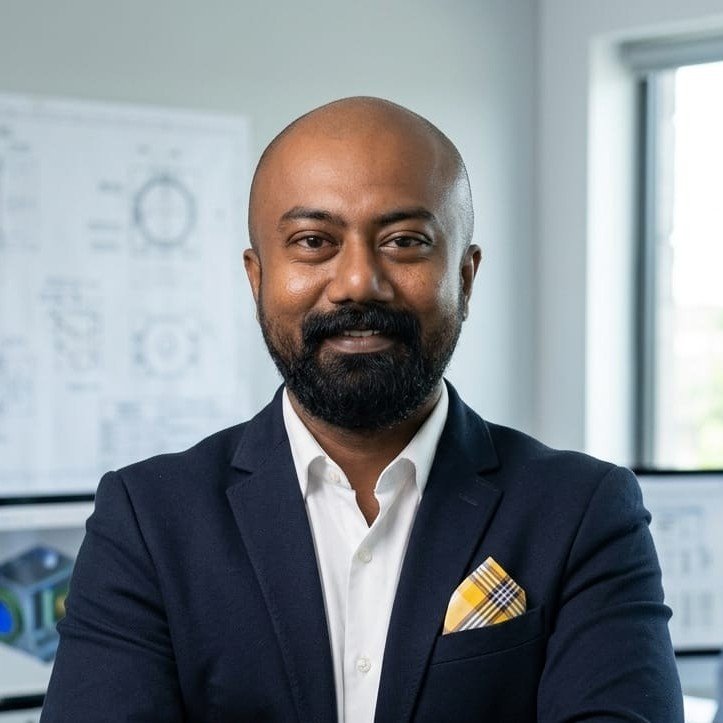
Karthikayan B is a seasoned professional with over 10 years of experience in CAD engineering, 3D modeling, visualization, corporate training, and project management. Starting his career in 2011 as a CAD Draftsman, he has progressed through various roles involving site design, 3D visualization, and advanced training delivery.
As a skilled communicator and corporate trainer, he excels in delivering training on IT-related products, Autodesk AEC/M&E solutions, and design software. He has successfully trained professionals at institutions and corporations across the globe, including Ghana, Oman, Sri Lanka, Malaysia, Bangladesh, and multiple cities in India.
His expertise in business profit maneuvering is reflected through revenue generation, operational management, and curriculum development in diverse international locations. Karthikayan has conducted numerous workshops and corporate training programs, helping professionals enhance their skills in advanced design and visualization tools.
Flexible and analytical with a keen eye for detail, he is passionate about 3D modeling, visualization, and training, with a strong appetite for adopting new technologies. His extensive international exposure and hands-on experience enable him to approach training with seriousness, diligence, and a clear focus on real-world industry applications.
| Day | Timing | Classes Type | Class Hour’s |
|---|---|---|---|
| Monday | 10:00 AM – 09:00 PM | Batches | 2 Hours Session |
| Wednesday | 12:00 PM – 09:00 PM | One to one | 2 Hours Session |
| Thursday | 10:00 AM – 09:00 PM | One to one | 2 Hours Session |
| Friday | 12:00 PM – 09:00 PM | Private | 2 Hours Session |
| Saturday | 10:00 AM – 09:00 PM | Batches | 2 Hours Session |
| Sunday | 10:00 AM – 09:00 PM | One to one | 2 Hours Session |
Autodesk Navisworks is a project review and BIM coordination software that allows architects, engineers, and construction professionals to combine 3D models from multiple disciplines — architecture, structure, MEP — into a single federated environment for clash detection, 4D sequencing, and construction coordination. In Dubai, Navisworks is the primary tool used by BIM coordinators to meet Dubai Municipality’s BIM submission requirements under Circular 207, which made BIM mandatory for buildings above 20 floors or exceeding 20,000 square metres in architectural area from January 2024. Navisworks training in Dubai at Orbit equips professionals to deliver clash-free, coordinated models that meet Dubai Municipality and Trakhees submission standards on live projects.
Dubai’s construction pipeline has made Navisworks proficiency a baseline requirement for BIM roles across the emirate. According to Dubai Land Department data, real estate transactions in Dubai reached AED 761 billion in 2024 — a record high that reflects the scale of active development requiring BIM coordination.
Dubai Municipality Circular 207 mandates BIM model submissions for all buildings above 20 floors and government projects, with Autodesk Navisworks named as the coordination tool specified for multi-discipline clash detection by Dubai Municipality and Trakhees.
Firms working on towers in Business Bay, DIFC, and Dubai Marina rely on Navisworks for MEP clash resolution within constrained ceiling voids — a standard requirement on every major Dubai high-rise.
Emaar, Nakheel, DEWA, RTA, and Aldar all require BIM coordination on their active project pipelines, and BIM Coordinators with Navisworks skills earn between AED 12,000 and AED 18,000 per month in Dubai.
This Navisworks training course teaches you to work in the exact workflows Dubai project teams use on active sites. You will learn to aggregate Revit, AutoCAD, and IFC models into a federated NWD file, configure Clash Detective to run automated rule-based clash detection across architecture, structure, and MEP disciplines, generate and distribute coordination reports, and build 4D construction sequences using the Timeliner tool linked to a project programme.
As a practical exercise, you will run a full coordination cycle on a multi-storey Dubai commercial project model — detecting clashes between structural beams and MEP ductwork, producing a clash register, and tracking resolutions to close-out.
The course covers 30–35 hours across 2-hour sessions, structured to fit around working schedules.
This Navisworks course is open to anyone — no prior Navisworks experience is required, though working knowledge of Revit or AutoCAD is helpful.
The course is designed for BIM Coordinators and Managers managing multi-discipline coordination, MEP Engineers responsible for ductwork and piping clash resolution, Architects and Structural Engineers involved in federated model reviews, Construction Managers and Site Engineers planning 4D sequencing, and fresh graduates entering the BIM and construction coordination field.
Working professionals in Dubai’s AEC sector join this course to formalise their Navisworks skills for BIM Coordinator roles. Fresh graduates use it as the entry qualification for BIM Modeller and Technician positions — roles that are actively hiring across Dubai’s ongoing construction projects.
| Job Title | Navisworks Application | AED Monthly Salary |
|---|---|---|
| BIM Modeller | Model creation and federated file assembly | AED 8,000–12,000/month |
| BIM Coordinator | Clash detection, coordination reports, BEP delivery | AED 12,000–18,000/month |
| MEP BIM Engineer | MEP clash resolution, ductwork and piping coordination | AED 10,000–16,000/month |
| BIM Manager | Federated model oversight, DM submission management | AED 20,000–35,000/month |
| Digital Delivery Lead | Full project BIM workflow from design to handover | AED 25,000+/month |
These figures are consistent with data from Augmintech’s 2025 BIM career survey for UAE and GCC markets. Dubai’s 2040 Urban Master Plan expansion across five urban centres, combined with ongoing mega-project delivery for DEWA, RTA, and Dubai South, means demand for Navisworks-skilled coordinators will grow through the decade.
Freelance BIM coordination consultancy in Dubai typically earns AED 150–350 per hour depending on project size and discipline scope.
Karthikayan Balamurugan, CAD and BIM trainer with 15 years of experience, has trained over 2,000 professionals at Orbit Training Centre across AutoCAD, Revit, STAAD Pro, and BIM coordination disciplines. His training approach is built around the coordination workflows Dubai employers actually use — not generic software walkthroughs.
The free demo session at Orbit includes a live Navisworks software walkthrough, a Q&A with Mukesh on your current project challenges and career goals, and a sample clash detection exercise so you can assess course fit before enrolling. This takes around 60–90 minutes and gives you a direct experience of the training approach.
One-to-one training at Orbit lets you progress at your own pace — if you already understand BIM workflows and just need to build Navisworks-specific skills, one-to-one sessions can cover in 15–20 hours what a standard batch covers in 30–35. That speed advantage is significant for professionals who cannot take extended time off active projects.
Post-training support includes continued access to course materials, the ability to send direct queries to Mukesh for 30 days after completion, and guidance on certification documentation for UAE employer recognition.
The curriculum is aligned to Dubai Municipality BIM submission standards — so what you practise in training maps directly to what your employer will ask of you on a DM-mandated project. The certificate is KHDA-aligned and recognised by UAE employers in the AEC sector.
Autodesk Navisworks is a project review and coordination software that aggregates 3D models from multiple design disciplines and file formats — Revit, AutoCAD, IFC, and others — into a single federated model, allowing project teams to review, analyze, and coordinate a complete building or infrastructure design without needing to open each discipline’s original authoring software. Unlike Revit or AutoCAD, Navisworks isn’t used to create design content; it’s used to combine and interrogate content that’s already been created elsewhere, which makes it the standard tool for the coordination stage of a BIM workflow rather than the design stage. Its core function, Clash Detective, runs automated rule-based checks across the federated model to identify physical conflicts between disciplines — a structural beam intersecting with an MEP duct, for example — before those conflicts are discovered during actual construction. Navisworks also includes Timeliner, a tool for building 4D construction sequences that link the 3D model to a project schedule, letting teams visualize how construction will actually unfold over time. In Dubai specifically, Navisworks carries added regulatory weight: Dubai Municipality Circular 207 names it directly as the coordination tool required for multi-discipline clash detection on buildings above 20 floors and government projects.
The primary use case is multi-discipline coordination on active construction projects: BIM Coordinators and Managers aggregate the architectural, structural, and MEP models from a project’s various design teams into one federated NWD file, then run Clash Detective to systematically identify every point where disciplines conflict spatially. This catches problems — ductwork running through a structural beam, a sprinkler pipe clashing with an electrical conduit — while they’re still cheap and easy to fix on a screen, rather than expensive and disruptive to fix once concrete has been poured or steel has been erected. Beyond clash detection, Navisworks is used to generate and distribute coordination reports that track which clashes have been identified, assigned to a responsible discipline, and resolved — a documentation trail that’s often required for project handover and quality assurance purposes on large Dubai developments. The Timeliner tool extends Navisworks beyond spatial coordination into time-based planning, letting construction managers and BIM Coordinators build and visualize a 4D construction sequence linked to the actual project programme, which is increasingly used to communicate construction logistics and phasing to clients and site teams in a far more intuitive way than a traditional Gantt chart alone.
The course teaches the exact workflows Dubai project teams use on active sites, starting with aggregating Revit, AutoCAD, and IFC models into a single federated NWD file — the foundational skill everything else in the course depends on. From there, you configure Clash Detective to run automated rule-based clash detection across architecture, structure, and MEP disciplines, learning not just how to run a clash test but how to set up rules that surface meaningful conflicts rather than overwhelming you with trivial tolerance clashes. You’ll learn to generate and distribute coordination reports in the format Dubai project teams actually use for tracking clash resolution, and build 4D construction sequences using the Timeliner tool linked to a real project programme. As the course’s central practical exercise, you run a full coordination cycle on a multi-storey Dubai commercial project model — detecting clashes between structural beams and MEP ductwork, producing a clash register, and tracking resolutions through to close-out, mirroring exactly the coordination cycle a working BIM Coordinator manages on a real project rather than a simplified textbook example. This end-to-end exercise is deliberately the centerpiece of the curriculum, because coordination judgment — knowing which clashes matter and how to communicate them clearly — is harder to teach through isolated exercises than through one complete, realistic project cycle.
Dubai’s construction pipeline, reflected in the AED 761 billion in real estate transactions recorded by the Dubai Land Department in 2024, generates an enormous volume of active, complex, multi-discipline projects where coordination errors carry real financial consequences — rework on a high-rise tower in Business Bay or DIFC, where MEP systems have to be squeezed into tightly constrained ceiling voids, can be extraordinarily expensive if a clash isn’t caught until construction is underway. This is precisely why Dubai Municipality mandated Navisworks-based coordination for larger and government projects: the cost of catching a clash on screen versus on site is not a marginal difference, it’s often the difference between a minor design adjustment and a major schedule and budget disruption. As Dubai’s 2040 Urban Master Plan drives continued mega-project delivery across five urban centres, and as major project owners like DEWA, RTA, and Dubai South continue commissioning BIM-mandated infrastructure, the demand for Navisworks-skilled coordinators is set to keep growing through the decade — reinforced by data from Augmintech’s 2025 BIM career survey for UAE and GCC markets showing sustained hiring demand in this specific skill area.
BIM Modellers, responsible for model creation and federated file assembly, typically earn AED 8,000–12,000 per month, serving as the entry point into coordination-focused BIM roles. With experience managing clash detection, coordination reports, and BEP (BIM Execution Plan) delivery, professionals move into BIM Coordinator roles earning AED 12,000–18,000 per month — the role most students in this course are directly targeting. MEP BIM Engineers, who specialize specifically in MEP clash resolution and ductwork and piping coordination, earn AED 10,000–16,000 per month, reflecting the technical depth required in that discipline-specific coordination work. BIM Managers, overseeing federated model management and Dubai Municipality submission processes across an entire project or portfolio, earn AED 20,000–35,000 per month. At the senior end, Digital Delivery Leads managing the full project BIM workflow from design through handover can earn AED 25,000 or more per month. Freelance BIM coordination consultancy is also active in Dubai, typically earning AED 150–350 per hour depending on project size and discipline scope, a viable path for experienced coordinators who prefer project-based independence.
Karthikayan Balamurugan, CAD and BIM trainer with 15 years of experience, has trained over 2,000 professionals at Orbit Training Centre across AutoCAD, Revit, STAAD Pro, and BIM coordination disciplines, with a training approach built around the coordination workflows Dubai employers actually use rather than generic software walkthroughs. The free demo session includes a live Navisworks software walkthrough, a Q&A on your current project challenges and career goals, and a sample clash detection exercise, taking around 60–90 minutes to give you a direct, hands-on sense of the training approach before enrolling. One-to-one training lets you progress at your own pace — professionals who already understand BIM workflows and just need Navisworks-specific skills can cover in 15–20 hours what a standard batch covers in 30–35, a meaningful advantage for anyone who can’t take extended time away from active projects. Post-training support includes continued access to course materials, direct queries to the trainer for 30 days after completion, and guidance on certification documentation for UAE employer recognition. The curriculum is aligned to Dubai Municipality BIM submission standards, so what you practice in training maps directly onto what your employer will ask of you on a DM-mandated project, and the certificate is KHDA-aligned and recognised across the UAE’s AEC sector.
New Navisworks users frequently make the same mistake when they first start running Clash Detective: they set overly broad or overly strict clash rules and end up with a report listing hundreds of clashes, the vast majority of which are trivial tolerance overlaps that don’t represent a real construction problem, which buries the genuine, actionable conflicts in noise and wastes the coordination team’s time sorting through them. Orbit’s course addresses this directly by teaching clash rule configuration as its own deliberate skill — setting appropriate tolerances for different types of clashes, distinguishing hard clashes that require redesign from clearance issues that may be acceptable — rather than treating “run the clash test” as the entire job. The other recurring problem self-taught Navisworks users hit is producing a clash report that lists conflicts clearly but fails to communicate ownership and urgency, leaving other disciplines unsure of what to actually do with the information — a report is only useful if it drives resolution, not just documentation. This course’s full coordination cycle exercise, which tracks clashes from initial detection through to resolution close-out, is built specifically to teach that communication and accountability loop, since it’s the part of the BIM Coordinator role that determines whether coordination actually prevents rework or just generates paperwork that gets ignored.
Whether you’re a BIM Coordinator or Manager formalizing skills you’ve picked up informally, an MEP Engineer responsible for ductwork and piping clash resolution, an architect or structural engineer involved in federated model reviews, or a fresh graduate entering the BIM and construction coordination field, the course meets you at your actual level of BIM experience. A working knowledge of Revit or AutoCAD is helpful but not required — the course is designed to be accessible even without prior Navisworks exposure. Book a free demo session to experience the coordination workflow firsthand, discuss your career goals directly with the trainer, and see exactly how the course maps to the BIM Coordinator, MEP BIM Engineer, or BIM Manager role you’re targeting.
Autodesk Navisworks is used in Dubai to combine 3D models from architecture, structure, and MEP disciplines into one federated environment for clash detection, 4D construction simulation, and coordination reporting. It is the primary tool specified by Dubai Municipality and Trakhees for multi-discipline BIM coordination on buildings above 20 floors. Professionals use it to detect conflicts — such as MEP ducts running through structural beams — before construction begins, avoiding costly on-site variations.
The Navisworks training course at Orbit Training Centre in Dubai runs across 30–35 hours delivered in 2-hour sessions. Batch students typically complete the course in 4–6 weeks depending on the schedule chosen. One-to-one students with existing BIM knowledge can complete the core coordination skills in 15–20 hours. Both in-person and online live formats are available, with sessions scheduled on weekday and weekend slots to suit working professionals.
No prior Navisworks experience is required for this course. A working knowledge of Revit or AutoCAD is helpful — it speeds up understanding of how models are built before they are coordinated in Navisworks — but the course starts from the interface and navigation level. Working professionals, fresh graduates, and career changers from architecture, engineering, and construction backgrounds all join without Navisworks experience and complete the course successfully.
The Navisworks certificate from Orbit Training Centre is internationally recognised and UAE-accepted. The certificate is KHDA-aligned — the Knowledge and Human Development Authority oversees private training quality in Dubai, and KHDA alignment means UAE employers in architecture, engineering, and construction treat the certificate as a verified qualification. It is accepted by consultancies, contractors, and project owners including firms working on Dubai Municipality-mandated BIM projects.
BIM Coordinators with Navisworks clash detection and coordination skills earn between AED 12,000 and AED 18,000 per month in Dubai, based on 2025 UAE BIM career market data. BIM Modellers at entry level earn AED 8,000–12,000 per month, while BIM Managers overseeing full coordination workflows earn AED 20,000–35,000 per month. Dubai’s active construction pipeline — driven by the 2040 Urban Master Plan and ongoing mega-project delivery — keeps demand and salaries for BIM professionals consistently high.
Navisworks is generally more approachable than authoring software like Revit, because you’re not building a model from scratch — you’re aggregating, reviewing, and coordinating models that other disciplines have already created, which is a more analytical than technically demanding skill once you understand the workflow. The Clash Detective tool’s basic operation — selecting two sets of objects and running a clash test — is straightforward to pick up within the first couple of sessions. What takes longer to develop is the judgment side: knowing which clash rules to set up so the software surfaces meaningful conflicts rather than flooding you with hundreds of trivial tolerance clashes, and knowing how to prioritize and communicate a clash register so the right discipline actually fixes the right problem. Orbit’s course addresses this directly by running a full coordination cycle on a realistic multi-storey Dubai commercial project model, so you practice the judgment calls — not just the button clicks — that separate someone who can technically run Navisworks from someone who can actually manage coordination on a live project. Students with prior Revit or AutoCAD exposure tend to grasp the federated model concept faster, but no prior BIM software experience is required to start.
Navisworks remains the clash detection tool most specifically named in Dubai project requirements — Dubai Municipality Circular 207 names Autodesk Navisworks directly as the coordination tool specified for multi-discipline clash detection on buildings above 20 floors and government projects, which gives it a regulatory edge that alternative tools don’t carry in this market. BIM Collaborate Pro (formerly BIM 360) offers cloud-based coordination and is increasingly used alongside Navisworks for issue tracking and worksharing rather than as a replacement for it, while Solibri is used by some international consultancies but has a smaller footprint in Dubai specifically compared to markets like Northern Europe where it originated. For Dubai-based BIM Coordinator roles, Navisworks is the clearly dominant and most consistently required skill, and it’s the tool named directly in official coordination mandates — making it the safer, more employable first choice over alternative clash detection platforms.
Firms delivering high-rise towers in Business Bay, DIFC, and Dubai Marina are consistent employers, since Navisworks is used to resolve MEP clash conflicts within the tight ceiling voids typical of Dubai high-rise construction — a standard, non-negotiable requirement on virtually every major tower project. Major developers including Emaar, Nakheel, DEWA, RTA, and Aldar require BIM coordination across their active project pipelines, hiring both directly and through the consultancies and contractors delivering their projects. Main contractors increasingly run in-house coordination teams during construction to manage federated model reviews independently of the design consultant, expanding Navisworks demand beyond design-stage consultancies into the construction phase itself. Government and semi-government entities, including those governed by Trakhees regulations, also specify Navisworks-based coordination on their infrastructure and building projects, given the Dubai Municipality Circular 207 mandate applies directly to qualifying government work.
Yes, the Navisworks course runs both in-person at Orbit’s Dubai campus and as live, trainer-led online sessions, covering the same federated model aggregation, Clash Detective, coordination reporting, and Timeliner 4D sequencing curriculum either way. Online students work through the full coordination cycle on the multi-storey Dubai commercial project model via screen-share with the trainer, so you’re actively running clash detection and building coordination reports yourself rather than passively watching a demonstration. This format suits BIM Coordinators and MEP Engineers working active projects who need training around existing schedules, and the course carries the same KHDA-aligned certificate regardless of format, so your qualification holds identical weight with UAE employers whichever way you choose to study.
Navisworks is only as useful as the models feeding into it, so pairing it with authoring software is essential — professionals who haven’t yet built multi-discipline Revit skills benefit significantly from Orbit’s Revit BIM Course, which covers Architecture, Structure, and MEP together and already includes an introduction to Navisworks clash detection as part of its coordination workflow. For BIM Coordinators moving into construction sequencing and project scheduling roles, adding Microsoft Project skills extends the Timeliner-based 4D sequencing covered in this course into full project schedule management, a valuable pairing for professionals aiming at Digital Delivery Lead or project controls roles. Structural engineers whose models feed into Navisworks coordination often pair these skills with STAAD Pro structural analysis training, rounding out a complete structural design and BIM coordination profile that’s directly employable across Dubai’s major consultancies.