CCTV Installation Training Dubai: Hands-On Guide
Learn CCTV installation in Dubai: 40-hour hands-on course covering cameras, networking, storage, and UAE compliance. Start your technician career.
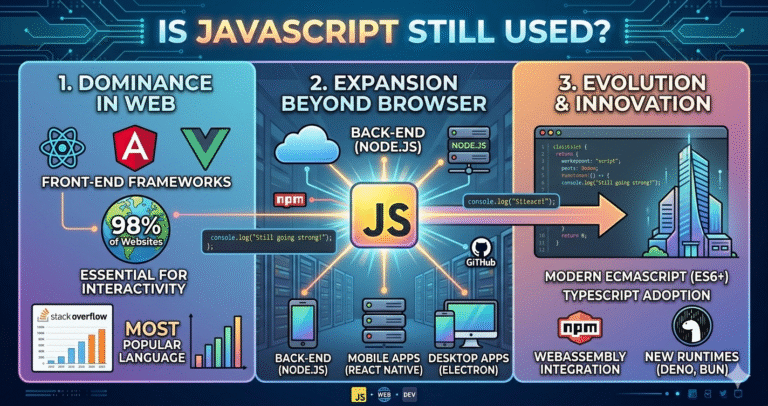
In a world where technology continuously evolves at breakneck speed, it’s fascinating to observe which tools stand the test of time. JavaScript, a language that once revolutionized web development, finds itself at the heart of this discussion. With so many new programming languages surfacing each year, you might wonder: is JavaScript still used as widely as it once was?
The answer is a resounding yes, and the reasons are both compelling and complex. Picture this: millions of websites across the globe rely on JavaScript to deliver dynamic user experiences, captivating audiences with interactive content and seamless functionality. In fact, a staggering 98.1% of all websites use JavaScript in some form (W3Techs March 2026 data), making it more dominant than ever. This solidifies its role not just as a relic of the past, but as a pillar of modern web development. Join us as we dive deeper into the enduring relevance of JavaScript, exploring how it continues to shape the landscape of the digital world.
JavaScript was born in 1995 when Brendan Eich created it in just 10 days for Netscape Navigator. Originally named Mocha, then LiveScript, it was renamed JavaScript to capitalize on Java’s popularity (despite having almost nothing in common). For its first decade, JavaScript lived mostly in browsers as a toy language for simple form validation and image rollovers.
The real transformation began in the mid-2000s:
Today JavaScript is the only language that runs natively in every browser, every mobile OS (via React Native, Ionic, Capacitor), every desktop OS (Electron, Tauri), every major cloud (serverless functions), and increasingly at the edge. No other language comes close to this level of universal reach. The ECMAScript committee releases a new edition every year, and browsers + Node/Bun/Deno implement features rapidly — keeping JavaScript perpetually modern. In short: JavaScript didn’t just survive; it became the default execution environment of the entire web and beyond.
In March 2026 JavaScript powers virtually the entire interactive web. According to W3Techs and HTTP Archive data, ~98.1% of websites use JavaScript, and ~97% of the top 1 million sites rely on it for core functionality. No other language even comes close.
Current usage breakdown (2026):
| Category | JavaScript Usage | Primary Frameworks/Runtimes |
|---|---|---|
| Frontend Web | ~98% | React, Next.js, Vue, Nuxt, Svelte, Angular, Solid, Qwik, Astro |
| Backend / APIs | ~42% of new projects | Node.js, Bun, Deno, Express, Fastify, NestJS, Hono, Elysia |
| Mobile Apps | ~38% of new cross-platform apps | React Native, Expo, Ionic, NativeScript, Capacitor |
| Desktop Apps | ~65% of new internal tools | Electron, Tauri 2, Neutralino |
| Edge / Serverless | ~78% of edge functions | Cloudflare Workers, Vercel Edge, Deno Deploy, Netlify Edge |
| WebAssembly Glue | ~92% of WASM apps | JS → Rust/Go/C++/AssemblyScript bindings |
JavaScript dominates because it offers:
Even organizations that use Python, Go, Rust, or .NET for core systems almost always use JavaScript/TypeScript for the customer-facing web layer. In 2026 JavaScript is not just still used — it is the connective tissue of the modern web.
JavaScript in 2026 (ECMAScript 2025/2026 features + runtime advancements) offers one of the richest feature sets of any mainstream language:
Runtime-specific superpowers in 2026:
JavaScript combines extreme expressiveness with production-grade performance and the broadest runtime coverage of any language — making it uniquely suited to solve almost any IT problem in 2026.
JavaScript’s ecosystem thrives on frameworks and meta-frameworks that dramatically increase developer productivity. State of the JavaScript frameworks in March 2026:
| Category | Leaders (2026) | Adoption Trend | Key Strength |
|---|---|---|---|
| Frontend UI | React, Vue 3, Svelte 5, SolidJS, Angular 19 | React stable, Svelte rising fast | Component model + ecosystem |
| Meta-Frameworks | Next.js 15, Nuxt 3, SvelteKit 2, Remix, Astro 5 | Next.js dominates | Full-stack + SSR/SSG/ISR |
| Backend Frameworks | Hono, Elysia, Fastify, NestJS, Express | Hono & Elysia surging | Sub-ms routing + TypeScript |
| UI Component Libraries | shadcn/ui, Radix + Tailwind, MUI Joy, Mantine, Chakra UI | shadcn/ui explosive growth | Copy-paste, fully customizable |
| Mobile | React Native + Expo, Ionic 8, NativeScript 8 | Expo dominates | Web developers → mobile |
| Desktop | Electron 32, Tauri 2, Neutralino | Tauri 2 gaining fast | Lightweight & secure |
JavaScript frameworks evolve extremely fast — new meta-frameworks and runtimes appear yearly, yet backward compatibility remains strong. This combination of innovation speed and stability explains why JavaScript retains such massive mindshare and adoption in 2026.
Frontend development remains JavaScript’s strongest domain in 2026. Virtually every interactive website uses JavaScript, and the language’s ecosystem has matured into a powerhouse for building complex, performant, accessible, and beautiful user interfaces.
Modern frontend JavaScript stack (2026 typical):
Performance numbers routinely achieved in production:
JavaScript frontend development in 2026 is characterized by extreme productivity (Vite hot module replacement, shadcn copy-paste components), outstanding performance (resumability, partial hydration, edge rendering), and accessibility-first design (Radix primitives). No other technology stack comes close to JavaScript’s combination of speed, ecosystem richness, and developer happiness for building modern web user interfaces.
Backend JavaScript has matured into a first-class citizen. In 2026 many organizations choose JavaScript/TypeScript for backend services — especially APIs, microservices, real-time systems, and serverless workloads.
Popular backend choices in 2026:
Typical performance numbers (2026 benchmarks):
JavaScript backends shine when:
They are less ideal for CPU-bound tasks (heavy computation, ML inference), where Go, Rust, or Java often win. But for the majority of web & mobile backends — APIs, authentication, real-time sync, webhooks — JavaScript offers the best combination of productivity, performance, and ecosystem support in 2026.
JavaScript remains one of the strongest choices for cross-platform mobile development in 2026. React Native dominates, but alternatives continue to gain ground.
Leading JavaScript-powered mobile solutions:
Typical 2026 React Native + Expo stack:
Advantages driving adoption:
While not ideal for high-performance games or heavy native integrations, JavaScript-based mobile development covers 80–90% of business apps, internal tools, e-commerce, social features, and SaaS mobile experiences — making it a cornerstone of cross-platform strategy in 2026.
JavaScript’s future through 2030 looks exceptionally strong. Key trends and predictions:
JavaScript’s unique position — universal runtime, largest ecosystem, fastest innovation cycle, best developer experience — makes it almost impossible to displace as the primary language of the web and beyond. Barring a black-swan event, JavaScript will remain the most used and most influential programming language through at least 2035.
The JavaScript community is the largest, most active, and most generous in software development. In 2026 it provides unmatched learning and support resources:
The community’s openness, rapid sharing of best practices, and willingness to teach newcomers create a virtuous cycle that keeps JavaScript at the forefront of innovation. New developers can go from zero to production-ready full-stack app in months — a feat unmatched by most other language ecosystems.
JavaScript is not just still used — it is more dominant and more essential in 2026 than at any point in its history. It runs everywhere: browsers, servers, mobile devices, desktops, edge networks, IoT devices, and increasingly embedded systems. Its ecosystem is the richest, its innovation cycle the fastest, its talent pool the deepest, and its developer experience among the best.
Whether you are building:
JavaScript — usually with TypeScript — is almost certainly the most productive, scalable, and future-proof choice. The language has not only survived every predicted death; it has thrived by continuously reinventing itself while preserving backward compatibility and universal reach.
The timeless value of JavaScript lies in its simplicity, universality, and relentless improvement. Learn it deeply, master TypeScript, and embrace the modern ecosystem — and you will be equipped to solve almost any software problem for the next decade and beyond. JavaScript isn’t going anywhere — it’s only getting stronger.
Check out our JavaScript Course
Learn CCTV installation in Dubai: 40-hour hands-on course covering cameras, networking, storage, and UAE compliance. Start your technician career.