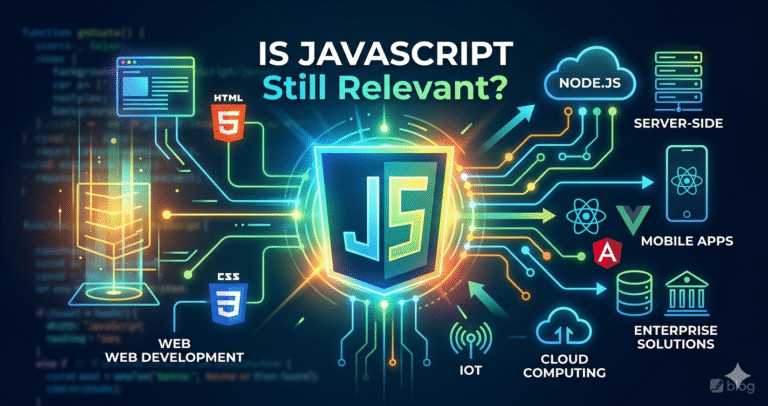
Every time you scroll Instagram, watch Netflix, check your bank balance online, play a browser game, or chat with an AI like me — JavaScript is quietly doing most of the work behind the scenes. Even in 2026, when there are dozens of newer languages and shiny tools, JavaScript is still everywhere. In fact, it’s more everywhere than ever.
Recent numbers (early 2026) show that over 98% of all websites use JavaScript. That’s not just old sites — it includes brand-new apps, luxury brand experiences, government portals, online classrooms, trading platforms, fitness trackers, and almost every SaaS product you pay for monthly. So the short answer is: yes — JavaScript is not just relevant; it’s still the heartbeat of the modern internet. Let’s look at why it refuses to fade away.
The Evolution of JavaScript Over Time
JavaScript started life in 1995 as a quick way to make web pages “do things” — think image rollovers, popup alerts, and form checks. Back then people called it a “toy language.” Fast-forward three decades and it’s powering billion-dollar companies, mobile apps, desktop software, video games, servers, smart TVs, refrigerators, and even parts of spacecraft control interfaces.
Here’s how it grew up:
- 1995–2005 — mostly simple animations and form validation
- 2006–2010 — jQuery made it easy to do cool stuff in every browser
- 2009 — Node.js let JavaScript run on servers (suddenly it wasn’t just for websites)
- 2015 — ES6 arrived with cleaner, more powerful syntax (arrow functions, promises, classes, modules)
- 2016–2020 — React, Vue, Angular took over front-end; people started building entire apps in JavaScript
- 2021–2023 — TypeScript became almost mandatory for big projects; tools like Vite made development lightning-fast
- 2024–2026 — edge computing, AI code assistants, server components, resumability (Qwik), signals (Svelte 5), Bun runtime, massive adoption in mobile (React Native + Expo), desktop (Tauri 2), and even embedded/IoT devices
JavaScript didn’t win by being the fastest or prettiest language. It won by being everywhere, improving every year, and letting developers build almost anything without learning five different languages. In 2026 it’s still growing faster than almost any other language — not because it’s perfect, but because it’s practical and the community never stops pushing it forward.
JavaScript’s Role in Modern Web Development
Almost every website or web app you use today needs JavaScript to feel alive. Static HTML can show text and pictures, but only JavaScript can:
- Let you like a post without reloading the page
- Show search results as you type
- Play videos with custom controls
- Update your shopping cart live
- Let two people edit the same document at once
- Animate beautiful transitions and effects
Current real-world examples (2026):
| What You Do | Powered by JavaScript |
|---|
| Scroll TikTok / Instagram Reels | Infinite scroll, video preloading, gesture controls |
| Watch Netflix / YouTube | Adaptive streaming, subtitles, picture-in-picture |
| Online banking / trading | Real-time balances, charts, secure forms |
| Google Maps / Uber | Live location tracking, route calculation |
| Figma / Canva / Notion | Real-time collaborative editing |
| ChatGPT / Grok / Claude web | Streaming responses, markdown rendering |
JavaScript is the reason the web no longer feels like flipping through a magazine — it feels like using an app. In 2026 even governments, banks, hospitals, and schools expect websites to behave like native apps — and JavaScript is the only language that can deliver that experience everywhere without plugins or downloads.
The Versatility of JavaScript Frameworks
JavaScript’s power today comes largely from frameworks — ready-made toolkits that let developers build complex apps much faster. In 2026 the most popular choices cover almost every need:
- React — still the king for interactive UIs (used by Facebook, Instagram, Netflix, Airbnb, Shopify)
- Next.js — React + server-side rendering, static generation, edge functions (powers Vercel, huge in startups & e-commerce)
- Vue 3 / Nuxt — loved for simplicity and great documentation (popular in Europe & Asia)
- Svelte 5 / SvelteKit — fastest-growing — compiles to very small, very fast code (great for performance-critical apps)
- SolidJS — extreme performance with familiar React-like syntax
- Astro — ships almost zero JavaScript by default — perfect for blogs, marketing sites, docs
- Qwik — resumability — apps become interactive in < 50 ms even on slow connections
These frameworks let teams build:
- Netflix-style video streaming apps
- Figma-style collaborative editors
- Instagram-like social feeds
- Trading dashboards with live charts
- E-commerce checkouts with 1-click payments
- AI chat interfaces that feel instant
The best part? You don’t need to learn five different languages — master JavaScript + TypeScript and you can use almost any of these tools. That’s why companies keep choosing JavaScript — it’s productive, fast, and the talent is everywhere.
Impact of JavaScript on User Experience
JavaScript is the reason the modern web feels alive. Without it, websites would still be static pages that reload every time you click anything. With JavaScript, everything can happen instantly and smoothly. Here’s how it shapes what you actually feel when you use the internet:
- No more waiting — You type in a search box and results appear before you finish typing
- Feels like an app — Scrolling TikTok, swiping on Tinder, dragging in Figma — all smooth and responsive
- Real-time magic — See someone typing in a chat, watch a collaborative document update live, see stock prices move second-by-second
- Beautiful details — Subtle hover effects, animated page transitions, loading spinners that don’t feel annoying
- Works everywhere — Same experience on phone, tablet, laptop, smart TV
In 2026 users expect:
- Pages to load in under 2 seconds
- Typing to feel instant
- Scrolling to be buttery smooth
- Dark/light mode switching without reload
- Offline support for key features
JavaScript (and frameworks like React, Svelte, Vue) makes all of that possible — and fast. That’s why even traditional companies (banks, airlines, governments) now invest heavily in JavaScript teams — because customers notice the difference between a “website” and an “experience.”
JavaScript in Server-Side Development
One of JavaScript’s biggest wins has been moving to servers. Thanks to Node.js (2009), Bun (2022), and Deno (2020), JavaScript now runs on servers, cloud functions, edge networks — everywhere.
Where JavaScript powers the backend today:
- PayPal — one of the first big companies to go all-in on Node.js
- Netflix — uses Node for its API layer
- LinkedIn — rebuilt mobile backend in Node
- Uber — real-time driver/passenger matching
- Shopify — large parts of their platform
- Vercel, Cloudflare, Netlify — billions of requests/day at the edge
Why companies choose JavaScript for backend work:
- Same language as frontend → smaller teams, less context switching
- Huge talent pool — easy to hire full-stack developers
- Lightning-fast prototyping → build APIs in hours
- Excellent real-time support (chat, live updates, multiplayer)
- Edge computing friendly — code runs close to users
In 2026 JavaScript backends are especially popular for:
- Startups & SaaS products
- Real-time apps (chat, dashboards, collaboration tools)
- Serverless & edge APIs
- Internal tools & admin panels
While not always the best for heavy number-crunching (e.g., machine learning training), JavaScript handles 80–90% of typical web backend needs with great speed and developer happiness.
Community Support and Resources for JavaScript Developers
The JavaScript community is one of the biggest reasons the language stays so strong. It’s huge, friendly, and moves incredibly fast. In 2026 you can learn almost anything about JavaScript for free — and get help quickly when you’re stuck.
Where developers go for help and learning:
- MDN Web Docs — the official, best-in-class reference (maintained by Mozilla + Google + Microsoft + Samsung)
- JavaScript.info — clearest modern JavaScript tutorial
- React.dev / Vuejs.org / Svelte.dev — official docs are excellent
- YouTube Channels — Fireship, Web Dev Simplified, Jack Herrington, Theo (t3.gg), Matt Pocock, Joshua Morony
- Communities — Reactiflux Discord, Reddit r/javascript, Stack Overflow, Dev.to
- Newsletters — JavaScript Weekly, Bytes, React Status, This Week in React
- Free Courses — freeCodeCamp, The Odin Project, Scrimba, Codecademy
The community also shares thousands of ready-made components (shadcn/ui, Radix, Mantine), starters (create-t3-app, create-next-app), and boilerplates — so developers rarely start from scratch. This generosity and speed of sharing is why JavaScript keeps improving faster than almost any other language — everyone helps everyone else.
Job Market Demand for JavaScript Skills
In 2026 JavaScript + TypeScript skills remain among the most in-demand in tech — across the world and especially in the United States, Europe, India, and Southeast Asia.
Typical job titles that require JavaScript:
- Frontend Developer
- Full-Stack Developer
- React / Next.js Developer
- Node.js / Backend Developer
- React Native / Mobile Developer
- Web3 / DApp Developer
- UI Engineer
- Technical Lead / Engineering Manager (almost always JavaScript experience)
Salary ranges (US, 2026 estimates):
- Junior Frontend — $80k–$120k
- Mid-level Full-Stack — $120k–$180k
- Senior React / Next.js — $160k–$250k+
- Staff / Principal Engineer (JavaScript heavy) — $200k–$400k+ (with equity)
JavaScript jobs are plentiful because:
- Every company with a website or app needs JavaScript developers
- Full-stack JavaScript developers can cover both frontend & backend
- Remote work is common — many roles are location-independent
- Freelance & contract work is abundant (Upwork, Toptal, Fiverr)
Even with AI coding assistants, demand for skilled JavaScript developers remains high — because humans are still needed to architect systems, make trade-offs, review code, integrate services, handle edge cases, and ensure security & accessibility. JavaScript skills in 2026 continue to open more doors than almost any other single technology.
Future Prospects: Where is JavaScript Heading?
JavaScript is not slowing down — it’s accelerating. Here’s what the next 5–10 years look like based on current momentum (2026 perspective):
- Even faster runtimes — Bun, Deno, and future Node versions keep pushing performance higher
- Edge everywhere — more logic moves to the edge (closer to users) → lower latency, cheaper infrastructure
- AI-native development — coding assistants become primary pair programmers; designers describe features in English → JavaScript code generated
- Full unification — single codebase for web, mobile, desktop, server, edge, VR/AR
- Stronger types & safety — TypeScript usage approaches 90–95% for professional code
- Web as platform — more native apps replaced by progressive web apps (PWAs) powered by JavaScript
JavaScript’s biggest advantages for the future:
- Already everywhere — no new runtime needed
- Huge talent pool — easiest language to hire for
- Fastest community innovation — new ideas land first in JavaScript
- Backward compatibility — old code still runs in 2035
Prediction: by 2030 JavaScript will still be the #1 language by usage, jobs, and ecosystem size — not because it’s the best at everything, but because it’s the most practical, universal, and continuously improving language for building almost anything digital. Its relevance isn’t fading — it’s expanding.
Conclusion: The Timeless Value of JavaScript
JavaScript isn’t just still relevant — it’s more important than ever in 2026. It runs the interactive web, powers mobile apps, desktop tools, servers, edge functions, IoT devices, and increasingly AI interfaces. No other language comes close to its reach, ecosystem size, developer community, or speed of improvement.
Whether you’re:
- Building the next consumer app
- Creating internal tools for your company
- Designing real-time collaboration features
- Running APIs that serve millions
- Prototyping new ideas quickly
JavaScript — especially with TypeScript — is almost always the smartest, fastest, and most future-proof choice. It’s not perfect, but it’s practical, universal, and backed by the largest, most creative developer community in the world. Learn JavaScript well, keep up with modern practices, and you’ll be equipped to build almost anything digital — today and for many years to come. JavaScript isn’t dying. It’s thriving — and it’s only getting stronger.
Check out our Advanced JavaScript Course