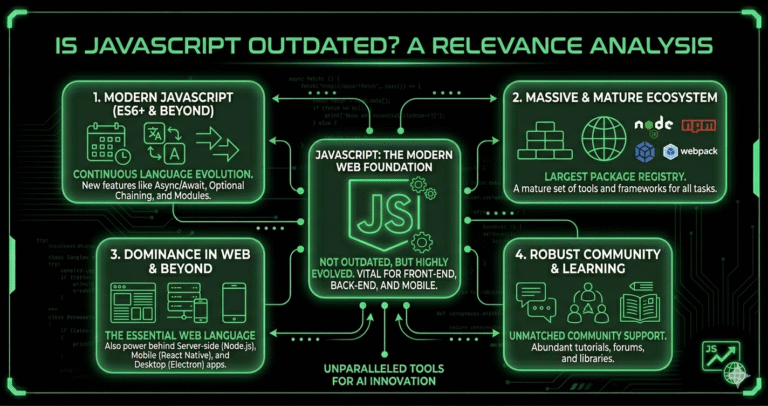
In the fast-moving world of technology, programming languages rise and fall quickly. New languages appear every year promising to solve the problems of the old ones. So it’s natural to ask: Is JavaScript outdated? With so many modern alternatives and constant hype around newer tools, many developers wonder if JavaScript has finally reached its expiration date. The short answer is a resounding no. In 2026, JavaScript is not only alive but more powerful, versatile, and widely used than ever before. It continues to power the vast majority of the interactive web, runs on servers, mobile devices, desktops, and even at the edge of the internet. This blog explores why JavaScript remains relevant, how it has evolved, and what its future looks like in today’s development landscape.
The Evolution of JavaScript Over Time
JavaScript was created in 1995 by Brendan Eich in just 10 days for Netscape Navigator. Originally called Mocha, then LiveScript, it was renamed JavaScript to capitalize on the popularity of Java — despite having almost nothing in common with it. For its first decade, JavaScript was mainly used for simple client-side interactions like form validation and image rollovers. Many professional developers dismissed it as a toy language due to its quirks and inconsistent browser implementations.
The real transformation began in the mid-2000s:
- 2006 — jQuery made DOM manipulation consistent and easy across browsers
- 2008 — Google’s V8 engine dramatically improved JavaScript performance
- 2009 — Node.js allowed JavaScript to run on the server side
- 2015 — ES6 (ECMAScript 2015) introduced modern features like arrow functions, classes, let/const, modules, and promises
- 2016–2026 — Annual updates with async/await, optional chaining, nullish coalescing, and top-level await
Today in 2026, JavaScript has evolved into a mature, full-featured language. Modern JavaScript (often called ES2025+) is clean, expressive, and powerful. Features like private class fields, pattern matching proposals, and improved error handling have addressed many historical criticisms. The language now supports both client and server environments seamlessly, and runtimes like Bun and Deno have pushed performance even further.
JavaScript’s evolution is unique because it maintained backward compatibility while continuously improving. Code written in 1999 still runs in modern browsers with minimal changes. This stability, combined with rapid innovation through the TC39 committee, has kept JavaScript relevant for over 30 years. No other language has achieved this level of universal adoption and continuous improvement simultaneously.
JavaScript’s Current Popularity and Usage Statistics
JavaScript’s dominance in 2026 is backed by overwhelming statistics that show it is far from outdated.
Key statistics in 2026:
| Metric | Value | Source |
|---|
| Websites using JavaScript | 98.1% | W3Techs |
| Most used language by developers | #1 for 14 consecutive years | Stack Overflow Developer Survey |
| Job postings requiring JavaScript/TypeScript | Over 75% | LinkedIn, Indeed |
| npm downloads per week | Over 30 billion | npm registry |
| Frameworks built on JavaScript | React, Vue, Svelte, Next.js, Astro, Qwik, etc. | State of JS 2025 |
JavaScript runs everywhere:
- Every web browser on the planet
- Server-side with Node.js, Bun, and Deno
- Mobile apps via React Native and Ionic
- Desktop applications with Electron and Tauri
- Edge computing platforms like Cloudflare Workers
- IoT devices and embedded systems
Even as new languages gain attention, JavaScript’s usage continues to grow. The reason is simple: it is the only language that runs natively in every browser. No other language offers this universal reach. Companies that try to avoid JavaScript on the frontend usually end up using it indirectly through WebAssembly or transpilation. In practice, JavaScript remains the foundation of the modern web.
The Versatility of Modern JavaScript Frameworks
One of the strongest arguments against the idea that JavaScript is outdated is the incredible ecosystem of frameworks and tools that continue to evolve rapidly in 2026.
Leading JavaScript frameworks and their strengths:
| Framework | Primary Strength | Popular Use Cases |
|---|
| React + Next.js | Component ecosystem & server components | Large-scale web apps, e-commerce |
| Vue 3 + Nuxt | Developer experience & progressive adoption | Startups, marketing sites |
| Svelte 5 + SvelteKit | Minimal runtime & excellent performance | High-performance apps |
| Astro | Content-first sites with zero JS by default | Blogs, marketing, documentation |
| Qwik | Resumability & instant interactivity | Performance-critical applications |
These frameworks address many historical criticisms of JavaScript:
- Bundle size and performance issues are solved by code splitting, islands architecture, and resumability
- Type safety is provided by TypeScript, which is now the standard for large projects
- Developer experience has improved dramatically with Vite, Turbopack, and modern tooling
- Production readiness is excellent with built-in SSR, SSG, and edge deployment options
The JavaScript ecosystem evolves faster than almost any other language. New features and frameworks appear regularly, keeping the language fresh and competitive. Far from being outdated, JavaScript’s framework landscape makes it one of the most innovative and adaptable development environments available today.
Job Market Demand and Real-World Usage
The job market provides clear evidence that JavaScript is far from outdated. In 2026, JavaScript and TypeScript skills remain among the most requested in developer job postings worldwide.
Current job market realities:
- Over 75% of web development positions list JavaScript or TypeScript as required skills
- Full-stack JavaScript roles (MERN, MEVN, Next.js stacks) are extremely common
- React Native developers are in high demand for cross-platform mobile apps
- Companies of all sizes — from startups to Fortune 500 — continue to build with JavaScript
- Even traditional enterprises are adopting modern JavaScript stacks for new projects
Major companies using JavaScript extensively in 2026 include Netflix, Airbnb, Uber, PayPal, LinkedIn, Instagram, and countless others. Many internal tools, admin panels, and customer-facing applications are built with JavaScript frameworks. The language’s ability to handle both frontend and backend with the same codebase (full-stack JavaScript) provides significant productivity and hiring advantages.
Developers who master modern JavaScript (with TypeScript, modern frameworks, and performance best practices) remain highly employable and well-compensated. Claims that JavaScript is outdated ignore the massive real-world usage and continued demand in the job market.
Challenges and Criticisms of JavaScript
JavaScript is not perfect. It has historical quirks, and some valid criticisms persist even in 2026. Understanding these helps appreciate why the language continues to evolve.
Common criticisms include:
- Loose typing (largely solved by TypeScript)
- Historical “bad parts” like hoisting and == vs ===
- Package management complexity (though npm has improved significantly)
- Performance compared to lower-level languages
- Fragmentation across different runtimes and frameworks
However, the JavaScript community has actively addressed many of these issues. TypeScript provides excellent type safety. Modern tooling (Vite, esbuild, SWC) delivers blazing-fast build times. Performance gaps are closing with runtimes like Bun and compilation targets like WebAssembly. The criticisms that remain are often outweighed by JavaScript’s universal availability and massive ecosystem advantages.
Most experienced developers view JavaScript’s flaws as manageable trade-offs rather than fatal weaknesses. The language’s ability to run everywhere continues to make it indispensable despite its imperfections.
Conclusion: JavaScript Is Far From Outdated
JavaScript is not outdated — it is more relevant and powerful in 2026 than at any point in its history. It powers nearly all interactive websites, runs on servers, mobile devices, desktops, and edge networks, and continues to evolve rapidly through annual language updates and an incredibly active ecosystem.
The evidence is clear:
- 98%+ of websites use JavaScript
- It remains the #1 language in developer surveys year after year
- Modern frameworks solve many historical problems
- Job demand for JavaScript skills remains extremely high
- The language continues to improve with better performance, tooling, and features
Rather than being outdated, JavaScript has matured into a versatile, full-stack language that adapts to new challenges. Developers who dismiss it as old-fashioned risk missing out on the most widely used and in-demand technology stack in web development today.
If you’re learning to code or advancing your career, investing in modern JavaScript (including TypeScript and current frameworks) is still one of the smartest decisions you can make. JavaScript isn’t going anywhere — it’s evolving, improving, and staying at the center of the digital world.
Check Out Our JavaScript Course at Orbit Training Center