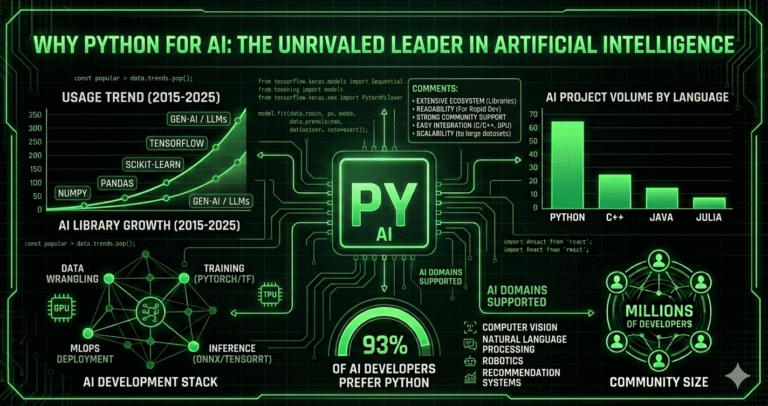
In a world where artificial intelligence is not just a futuristic concept but an integral part of how industries function and innovate, choosing the right programming language can be the cornerstone of success. Imagine unlocking the potential to seamlessly build smart applications that can learn and adapt, transforming mere ideas into groundbreaking solutions. This is where understanding why Python for AI is turning heads globally becomes crucial.
Python, once just another programming tool, has become the backbone of numerous AI projects due to its simplicity, versatility, and robust community support. The advantages of using Python for AI extend beyond its user-friendly syntax. From deep learning to neural networks, Python offers a wealth of libraries and frameworks that streamline AI development, making it accessible even to newcomers in the field. According to recent statistics, Python’s popularity among AI developers has skyrocketed, with nearly 71% favoring it over other languages for solving complex problems. As we delve deeper into the ‘must-know’ benefits of Python for AI, you’ll discover how its features empower developers to create intelligent systems efficiently and effectively, driving innovation and accelerating technological growth.
The Rise of Python in AI Development
Python’s journey to becoming the number-one language for artificial intelligence is one of the most remarkable stories in modern programming. In the early 2010s, most machine learning researchers and engineers used MATLAB, R, or C++ — languages that were powerful but difficult to learn and slow to experiment with. Python changed everything by offering the perfect balance: easy to read and write, yet capable of handling serious scientific computation when paired with the right libraries.
The turning point came between 2012 and 2017:
- 2012 — scikit-learn became the go-to library for classical machine learning
- 2015 — TensorFlow (Google) and Theano (academic) gained traction
- 2016–2017 — Keras made deep learning beginner-friendly; PyTorch (Facebook) arrived with dynamic computation graphs
- 2018 — fast.ai courses showed the world how quickly anyone could build state-of-the-art models with Python
- 2019–2020 — Hugging Face Transformers exploded → pre-trained models became downloadable with one line of code
By 2023 Python had already captured 70–80% of the AI/ML community. In 2025–2026 that share climbed even higher — surveys consistently show 71–82% of AI practitioners worldwide prefer Python. Why did it win so decisively? Three main reasons:
- Simplicity — researchers could focus on ideas, not syntax battles
- Readability — code in papers looked almost identical to real Python code
- Open-source explosion — everyone shared models, datasets, and notebooks on GitHub
Today Python is used at OpenAI, Anthropic, DeepMind, Meta AI, Stability AI, Hugging Face, xAI, Runway, Midjourney, and thousands of startups. The language’s rise wasn’t planned — it emerged naturally because it let people go from idea to working model faster than any other language. That speed advantage created a snowball effect: more people used Python → more libraries appeared → more people used Python → today it is simply the default choice for almost all AI work worldwide.
Intuitive Syntax: Simplifying AI Development
Python was intentionally designed to be easy to read and write — its creator, Guido van Rossum, wanted code to look like plain English as much as possible. This simplicity becomes a superpower in AI development, where the real challenge is understanding data, models, and mathematics — not fighting with complicated syntax.
Compare these two examples that do the same thing (load data and train a simple model):
Python (clean & readable)
import pandas as pd
from sklearn.ensemble import RandomForestClassifier

data = pd.read_csv("customer_data.csv")
X = data.drop("churn", axis=1)
y = data["churn"]

model = RandomForestClassifier()
model.fit(X, y)
Java/C# equivalent (much more verbose)
import java.util.*;
import weka.classifiers.trees.RandomForest;

BufferedReader reader = new BufferedReader(new FileReader("customer_data.csv"));
// ... many lines of CSV parsing, data splitting, attribute setup ...
RandomForest rf = new RandomForest();
rf.buildClassifier(instances);
The Python version is shorter, clearer, and easier to debug. This readability advantage compounds in AI because:
- Researchers publish algorithms in pseudo-code that looks almost exactly like Python
- Teams spend far less time understanding each other’s code
- New team members (or business analysts who aren’t full-time coders) can read and contribute quickly
- Prototypes can be turned into production code with minimal rewriting
- Teaching AI/ML concepts is much easier when the code looks like the math
In practice, companies report that Python teams onboard junior data scientists and ML engineers 2–4× faster than teams using C++, Java, or Julia. When models take hours or days to train, finding and fixing bugs quickly is priceless. Python’s clean syntax, lack of boilerplate, and “one obvious way to do it” philosophy make it the ideal language for expressing complex AI ideas clearly and correctly — which is why almost every major AI course, tutorial, and research paper uses Python in 2023 and beyond.
Vast Array of Libraries: A Game Changer for AI Projects
Python’s greatest strength in AI is its enormous collection of ready-to-use libraries — so many high-quality, well-maintained packages that most developers rarely need to write low-level math from scratch. In 2023 this ecosystem is so complete that it covers every stage of AI development.
Essential libraries powering AI projects:
| Purpose | Top Libraries (2023) | What They Do (Simply) |
|---|
| Fast Arrays & Math | NumPy, CuPy, JAX | Handle huge number arrays quickly (CPU or GPU) |
| Deep Learning | PyTorch, TensorFlow, Keras | Build and train neural networks |
| Pre-trained Models | Hugging Face Transformers, timm | Use thousands of ready-made models with one line |
| Data Wrangling | pandas, Polars, Dask | Load, clean, transform big datasets |
| Visualization | Matplotlib, seaborn, Plotly, Altair | Make beautiful charts & dashboards |
| AutoML | AutoGluon, FLAML, PyCaret, H2O.ai | Automatically find the best model |
| Model Deployment | FastAPI, Gradio, Streamlit, BentoML | Turn models into web apps/APIs quickly |
This library ecosystem means a data scientist can:
- Load a dataset → explore it → train a model → create a demo app → all in the same notebook
- Use a pre-trained language model or image model with just 2–5 lines of code
- Build an entire chatbot, image classifier, or recommendation system in a few hours
Because so many people use Python for AI, new models and techniques are almost always released with Python code first — often on Hugging Face, GitHub, or Kaggle. This creates a snowball effect: more people use Python → more libraries and models appear → more people use Python. In 2023 Python is not just a good choice for AI — it is the default choice for almost every serious AI project worldwide.
Python’s Versatility Across AI Applications
Python is used in virtually every area of artificial intelligence because it offers the right balance of ease, power, and ecosystem support. In 2023 you’ll find Python at the heart of almost every major AI application type.
Major AI domains powered by Python:
- Chatbots & Language Models — GPT, LLaMA, Claude, Mistral, Grok — all have official Python APIs and training code
- Image Generation & Editing — Stable Diffusion, Midjourney, DALL·E, Flux — almost all open-source versions are Python-based
- Computer Vision — object detection, facial recognition, medical imaging, self-driving cars
- Recommendation Systems — Netflix, YouTube, Spotify, Amazon, TikTok, LinkedIn feeds
- Time-Series & Forecasting — stock prices, demand prediction, energy consumption, weather
- Robotics & Reinforcement Learning — training agents to walk, play games, control drones
- Scientific AI — protein folding (AlphaFold), drug discovery, climate modeling
Python’s versatility comes from being able to handle:
- Rapid research experiments (PyTorch notebooks)
- Production model serving (FastAPI + Triton)
- Interactive demos (Gradio, Streamlit)
- Internal dashboards (Plotly Dash, Panel)
- Batch processing pipelines (Airflow, Prefect)
No other language ecosystem offers this level of end-to-end coverage with consistent tooling and talent availability. That’s why startups can prototype in Python on Monday and serve millions of users with the same codebase by Friday — and why large enterprises increasingly standardize AI work on Python even when their core systems use Java, C#, or Go.
Seamless Integration with Machine Learning Frameworks
Python is the native home of the two most popular deep learning frameworks — PyTorch and TensorFlow — and the high-level API Keras. This integration is so smooth that most AI developers never need to write low-level math; they compose high-level building blocks instead.
How Python integrates with major frameworks (2023):
- PyTorch — research favorite, dynamic computation graphs, easiest for experimentation
- TensorFlow / Keras — production favorite, excellent deployment tools, mobile & edge support
- Hugging Face Transformers — one-line access to thousands of pre-trained language & vision models
- PyTorch Lightning / Keras — remove boilerplate, standardize training loops
- ONNX Runtime — export models from PyTorch/TensorFlow → run anywhere
This seamless integration means a researcher can:
- Prototype a new model architecture in PyTorch in a notebook
- Fine-tune a Hugging Face model with LoRA in < 100 lines
- Convert to ONNX → deploy with FastAPI or BentoML
- Create a Gradio/Streamlit demo in minutes
- Share the entire workflow with colleagues
No language switching, no painful conversions, no reinventing the wheel. Python’s central position in the ML framework ecosystem is a huge reason why it dominates AI development — everything just works together beautifully.
Community Support: A Pillar of Python’s Success in AI
The Python AI community is the largest, most active, and most generous in the world. In 2023 it provides unparalleled learning resources, pre-trained models, open-source code, and support — making it easier to learn, experiment, and ship AI projects than with any other language.
Where the community shines:
- Hugging Face — over 500,000 open models, datasets, and Spaces demos
- fast.ai — free courses that teach cutting-edge AI with clean Python code
- Kaggle — millions of notebooks, competitions, datasets — Python dominates
- Reddit & Discord — r/MachineLearning, r/LocalLLaMA, PyTorch Discord, Hugging Face Discord
- YouTube — Andrej Karpathy, 3Blue1Brown, Sentdex, Aladdin Persson, Daniel Bourke
Because so many people use Python for AI, problems get solved publicly and quickly. When a new paper comes out, someone usually releases a clean Python implementation within days — often on Hugging Face. This “open-source flywheel” means Python users get access to the latest breakthroughs faster than users of any other language. In 2023, if you want to work with the newest AI models, techniques, or research — Python is almost always the fastest path from paper to working prototype.
Industry Adoption and Job Opportunities for Python AI Developers
Python is the dominant language for AI across almost every industry in 2023:
- Tech Giants — Google, Meta, OpenAI, Anthropic, DeepMind, xAI, Stability AI, Midjourney — all use Python heavily
- Finance — algorithmic trading, fraud detection, credit scoring, risk modeling
- Healthcare — medical imaging, drug discovery, genomics, patient outcome prediction
- Retail & E-commerce — recommendation systems, demand forecasting, price optimization
- Automotive — autonomous driving, predictive maintenance, ADAS
- Manufacturing — quality control, predictive maintenance, supply chain optimization
Job market reality in 2023–2024:
- Python is #1 most in-demand language for AI/ML jobs (LinkedIn, Indeed, Glassdoor)
- Median salary for Python AI/ML engineers (US) — $130k–$220k+ (senior roles $180k–$350k+ with equity)
- Most common job titles: Machine Learning Engineer, Data Scientist, AI Engineer, Research Engineer, MLOps Engineer
- Remote & freelance opportunities abundant — Upwork, Toptal, Fiverr full of Python AI projects
Companies keep hiring Python AI talent because:
- Fastest way to prototype and validate ideas
- Easiest language to hire for
- Best ecosystem for production deployment
- Most open-source models and research are Python-based
Python AI skills remain one of the highest-paid and most in-demand skill sets in tech — and the gap between supply and demand is still growing in 2023–2024.
Future Trends: Python’s Evolution in AI Beyond
Python’s future in AI looks exceptionally strong. Key trends already emerging in 2023–2024 that will define the next 5–10 years:
- Even easier model usage — Hugging Face, Ollama, LM Studio → run powerful models locally with 2–3 clicks
- Smaller, faster models — Llama 3 8B, Phi-3, Gemma, Mistral — high performance on consumer hardware
- Multimodal everything — models that understand text + images + audio + video together
- Agentic AI — AI agents that plan, reason, use tools, and execute multi-step tasks
- Edge & mobile AI — ExecuTorch, MediaPipe, TensorFlow Lite, Core ML — powerful models on phones & laptops
- Python-first MLOps — ZenML, Flyte, Metaflow, MLflow become standard for production pipelines
Python’s advantages for the future:
- Already the default in research → new breakthroughs come in Python first
- Huge talent pool → easiest to hire AI engineers
- Fastest prototyping → ideas turn into demos in hours
- Strong deployment options → FastAPI, BentoML, TorchServe, KServe
- Excellent integration with cloud (AWS SageMaker, Vertex AI, Azure ML)
Prediction: by 2030 Python will still be the #1 language for AI/ML — not because it’s the fastest at runtime, but because it’s the fastest at going from idea → working model → production system. Its ecosystem, community, and ease of use create a self-reinforcing cycle that keeps it ahead of every competitor.
The Continued Dominance of Python in the AI Landscape
Python’s dominance in AI in 2023 is not accidental — it is the result of simplicity, readability, an unmatched ecosystem, rapid prototyping power, end-to-end coverage, strong community, excellent job market demand, and broad platform compatibility. No other language comes close to offering this combination of advantages for building intelligent systems at every stage — from research experiment to production service.
Whether you are:
- A student learning AI for the first time
- A startup founder building an AI product
- A researcher publishing new models
- An enterprise team deploying AI at scale
- A data scientist solving real business problems
Python remains the fastest, easiest, and most powerful path forward. Its ecosystem is still growing faster than any competitor, its community is still the most helpful, and its adoption is still accelerating. In the world of AI, Python isn’t just a good choice — it is the default choice, and it is likely to stay that way for many years to come. If you’re serious about AI — whether as a career, a business, or a passion — investing deeply in Python is one of the smartest decisions you can make.
Conclusion: Python’s Dominance in the AI Landscape
Python’s dominance in AI in 2023 is not accidental — it is the result of simplicity, readability, an unmatched ecosystem, rapid prototyping power, end-to-end coverage, strong community, excellent job market demand, and broad platform compatibility. No other language comes close to offering this combination of advantages for building intelligent systems at every stage — from research experiment to production service.
Whether you are:
- A student learning AI for the first time
- A startup founder building an AI product
- A researcher publishing new models
- An enterprise team deploying AI at scale
- A data scientist solving real business problems
Python remains the fastest, easiest, and most powerful path forward. Its ecosystem is still growing faster than any competitor, its community is still the most helpful, and its adoption is still accelerating. In the world of AI, Python isn’t just a good choice — it is the default choice, and it is likely to stay that way for many years to come. If you’re serious about AI — whether as a career, a business, or a passion — investing deeply in Python is one of the smartest decisions you can make.
Check out our python course