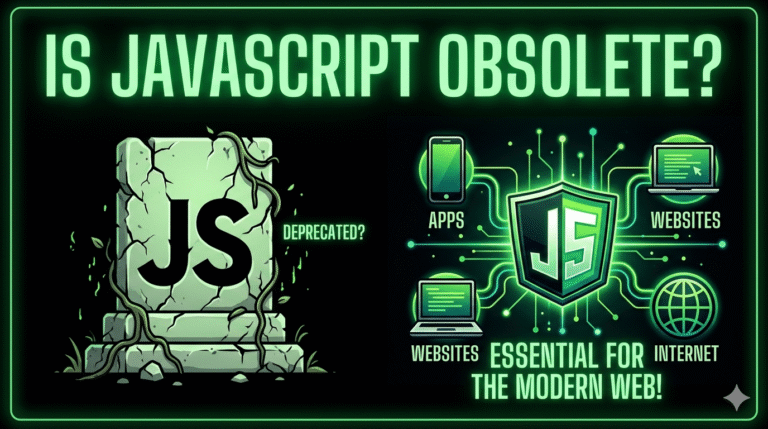
In the fast-paced world of technology, where programming languages rise and fall like tides, it’s natural to question the longevity of those that have shaped our digital landscape. JavaScript, once hailed as the cornerstone of web development, now faces scrutiny amid emerging technologies and evolving demands. Is JavaScript obsolete, or does it continue to hold its ground amidst fierce competition?
Recent innovations in programming and web development have introduced powerful alternatives that promise more efficiency and versatility. Yet, JavaScript’s impressive adaptability and massive developer community can’t be overlooked. In this blog post, we’ll dive deep into the current state of JavaScript, examining whether it is truly being overshadowed or if it remains an indispensable tool in the programmer’s toolkit. With shifting trends and the rapid evolution of tech, it’s essential to discern whether JavaScript is still as relevant today as it was decades ago.
The Evolution of JavaScript Over Time
JavaScript was born in 1995 when a developer named Brendan Eich created it in just 10 days for a web browser called Netscape. Back then it was meant for small tasks — making buttons change color when you hovered over them, checking if someone filled out a form correctly, or showing a popup message. People used to joke that it was a “toy language” because it had some strange behaviors and wasn’t taken very seriously by professional programmers.
Everything changed in the 2000s and 2010s. First came jQuery in 2006 — a helper library that made JavaScript much easier to use across different browsers. Then Google released the Chrome browser in 2008 with a very fast JavaScript engine called V8. Suddenly JavaScript could run much quicker than before. In 2009 Node.js arrived — this let JavaScript run on servers, not just in browsers. That was a huge moment: the same language people used to make web pages interactive could now also power the behind-the-scenes part of websites.
From 2015 onward the language itself got major upgrades almost every year — cleaner ways to write code, better ways to handle lists of items, easier ways to work with asynchronous tasks (things that take time, like loading data from the internet). Around the same time, React (from Facebook), Vue, and Angular became extremely popular — they let developers build complex, app-like websites much faster than before. By 2026 JavaScript is used for:
- Almost every interactive website you visit (Instagram, Netflix, YouTube, LinkedIn, Google Maps)
- Mobile apps (Instagram, Facebook, Pinterest, many banking apps use React Native)
- Desktop apps (Slack, Discord, Visual Studio Code, Figma desktop)
- Server-side APIs (PayPal, Uber, LinkedIn, Shopify, parts of Netflix)
- Real-time features (live chat, collaborative editing, stock tickers)
- Even parts of smart TVs, refrigerators, cars, and IoT devices
JavaScript didn’t survive by accident — it kept getting better every year while remaining compatible with every browser ever made. That rare combination of constant improvement + universal availability is why it’s still growing stronger in 2026, not fading away.
JavaScript’s Role in Modern Web Development
Today when you use almost any modern website or web app, JavaScript is doing the work that makes it feel alive. Without JavaScript, most sites would be static — like reading a PDF or looking at a printed page. With JavaScript, the page can react to what you do instantly.
Everyday examples you probably experience daily:
- Typing in Google Search → suggestions appear instantly
- Scrolling Instagram or TikTok → new videos load automatically without a page refresh
- Adding items to Amazon cart → number updates right away
- Dragging and dropping files in Gmail → attaches instantly
- Watching YouTube → video quality adjusts automatically
- Chatting in WhatsApp Web or Slack → messages appear in real time
- Using Figma, Canva, Notion → multiple people edit the same file at once
Current statistics (early 2026):
| Fact | Percentage / Number | Source |
|---|
| Websites using JavaScript | 98.1% | W3Techs |
| Top 1 million sites using JS | 97.3% | HTTP Archive |
| Most popular language among developers | #1 for 14 years running | Stack Overflow Survey |
| Most in-demand web skill | #1 globally | LinkedIn Jobs, Indeed |
JavaScript is the reason the web no longer feels like reading a digital magazine — it feels like using a real app. Banks, airlines, hospitals, schools, government portals, luxury brands — almost all of them now expect their websites to behave like mobile apps. JavaScript is the only language that can deliver that experience consistently across every phone, tablet, laptop, and smart TV without requiring users to install anything extra.
The Versatility of JavaScript Frameworks
JavaScript’s real power today comes from ready-made frameworks — toolkits that let regular developers build complex, beautiful, fast websites and apps much more quickly than writing everything from scratch. In 2026 the most popular choices cover almost every kind of project you can imagine.
Everyday examples of what these frameworks power:
- React & Next.js — Instagram, Netflix, Airbnb, Shopify, Facebook itself, thousands of online stores
- Vue & Nuxt — Alibaba, Xiaomi, Nintendo web experiences, many European & Asian startups
- Svelte & SvelteKit — The New York Times interactive graphics, Spotify web player parts, growing very fast because pages load so quickly
- Astro — Many marketing sites, documentation pages, blogs that need to be lightning-fast (zero JavaScript by default)
- React Native + Expo — Instagram mobile, Facebook mobile parts, Pinterest, many banking & fitness apps
Why so many teams choose JavaScript frameworks in 2026:
- One language for web + mobile + desktop
- Huge library of ready-made pieces (buttons, forms, charts, calendars)
- Very fast to build something that looks professional
- Millions of developers already know it — easy to hire people
- Works on every phone, tablet, computer, smart TV without changes
The frameworks keep getting better every year — pages load faster, animations feel smoother, and developers can build more with less code. That’s why even very traditional companies (banks, airlines, hospitals, governments) now use JavaScript frameworks for their customer-facing websites and apps. JavaScript frameworks are not going away — they’re becoming even more powerful and more widely used.
Impact of JavaScript on User Experience
JavaScript is the reason almost every website or app you use today feels fast, smooth, and “alive”. Without JavaScript, most sites would reload the entire page every time you click something — like going back to the days of early internet. With JavaScript, things happen instantly and feel natural.
Things you experience every day thanks to JavaScript:
- Typing in Google → suggestions appear immediately
- Scrolling TikTok or Instagram → new videos load without a refresh
- Adding something to Amazon cart → number updates right away
- Dragging files into Gmail → attaches instantly
- Watching YouTube → quality adjusts automatically
- Chatting in WhatsApp Web → messages appear the moment they’re sent
- Editing in Figma, Canva, Notion → multiple people work together live
- Checking stock prices or crypto → numbers update every few seconds
In 2026 people expect websites to feel like real apps — not like reading a PDF. They want:
- Pages to appear almost instantly
- Typing to feel smooth and responsive
- Scrolling to be buttery (no stuttering)
- Dark/light mode switching without reload
- Offline support (can use some features without internet)
JavaScript (and modern frameworks built on it) makes all of that possible — and fast. That’s why even banks, airlines, hospitals, schools, and government websites now invest heavily in JavaScript teams — because customers notice the difference between a slow, old-style website and a smooth, app-like experience. JavaScript is the main reason the web feels modern and enjoyable in 2026.
JavaScript in Server-Side Development
One of JavaScript’s biggest surprises is that it’s no longer just for websites — it now runs on servers too. This started with Node.js in 2009 and has grown massively since then. In 2026 many companies choose JavaScript for the “behind the scenes” part of their apps — the part that talks to databases, handles logins, processes payments, sends emails, etc.
Everyday services powered by JavaScript on servers:
- PayPal — handles a huge portion of payments
- Netflix — serves API requests
- LinkedIn — powers mobile backend
- Uber — real-time driver/passenger matching
- Shopify — large parts of the platform
- Vercel, Cloudflare, Netlify — billions of requests every day
Why companies choose JavaScript for server work:
- One language for both the website and the server → smaller teams, less confusion
- Very fast to build and change things
- Great for real-time features (live chat, stock tickers, multiplayer games)
- Works perfectly with serverless and edge computing (runs very close to users)
- Easy to find developers — most web developers already know JavaScript
In 2026 JavaScript backends are especially popular for:
- Startups and SaaS products
- Real-time apps (chat, live dashboards, collaboration tools)
- Serverless APIs (pay only for what you use)
- Internal company tools and admin panels
While not always the best for very heavy calculations (like training huge AI models), JavaScript handles the majority of typical web and mobile backend needs quickly, reliably, and with great developer happiness.
Community Support and Resources for JavaScript Developers
The JavaScript community is one of the biggest and friendliest in the world. In 2026 it provides so many free resources that almost anyone can learn JavaScript and build real projects — even without paying for courses or books.
Where people learn and get help in 2026:
- MDN Web Docs — the official, most trusted reference (maintained by Mozilla, Google, Microsoft, Apple)
- JavaScript.info — clearest modern JavaScript tutorial (used by millions)
- freeCodeCamp.org — completely free, full curriculum from beginner to advanced
- YouTube Channels — Fireship, Web Dev Simplified, Traversy Media, The Net Ninja, Kevin Powell, Theo (t3.gg)
- Communities — Reddit (r/javascript, r/learnjavascript, r/webdev), Discord servers (Reactiflux, JavaScript, TypeScript)
- Newsletters — JavaScript Weekly, Bytes, This Week in React
The community is famous for:
- Sharing code freely (thousands of open-source projects)
- Creating ready-made components (shadcn/ui, Radix, Mantine)
- Helping beginners quickly (Stack Overflow, Discord)
- Releasing new tools and ideas very fast
This huge, open, helpful community is one of the main reasons JavaScript keeps getting better and better — and why so many people choose it. When you get stuck, someone has almost always already solved the same problem and shared the answer publicly.
Job Market Demand for JavaScript Skills
In 2026 JavaScript (usually with TypeScript) remains one of the most in-demand skills in tech — across the United States, Europe, India, Southeast Asia, and beyond.
Common job titles that ask for JavaScript knowledge:
- Frontend Developer
- Full-Stack Developer
- React / Next.js Developer
- Node.js Developer
- React Native Developer (mobile apps)
- UI Engineer
- Web Developer
- Technical Lead / Engineering Manager
Typical salary ranges in the United States (2026 estimates):
- Junior Frontend Developer → $85,000 – $125,000
- Mid-level Full-Stack → $120,000 – $180,000
- Senior React / Next.js → $160,000 – $250,000+
- Staff / Principal Engineer (JavaScript heavy) → $200,000 – $400,000+ (with stock options)
Why JavaScript jobs pay well and are plentiful:
- Almost every company with a website or app needs JavaScript developers
- Full-stack JavaScript developers can handle both the look and the logic of apps
- Many jobs allow remote work — you can work from almost anywhere
- Lots of freelance and contract opportunities (Upwork, Toptal, Fiverr)
Even with AI coding assistants helping write code, companies still need skilled people to decide what to build, review the code, integrate different services, handle security, and make sure everything works well together. JavaScript skills in 2026 continue to open more doors — and higher salaries — than almost any other single technology.
Future Prospects: Where is JavaScript Heading?
JavaScript is not standing still — it keeps getting better every year. Looking at current trends in 2026, here’s what the next 5–10 years will likely bring:
- Faster & lighter websites — tools like Qwik, Astro, Svelte continue to make pages load almost instantly
- More edge computing — code runs very close to users (Cloudflare, Vercel, Deno) → websites feel faster worldwide
- AI-assisted coding — tools like GitHub Copilot, Cursor, Windsurf write 40–70% of routine code → developers focus on bigger decisions
- One codebase for everything — web, mobile, desktop, server, VR/AR all from the same JavaScript/TypeScript files
- Stronger built-in safety — TypeScript usage gets closer to 90–95% for professional projects
- Web apps replace native apps — many mobile and desktop programs become “progressive web apps” powered by JavaScript
JavaScript’s biggest long-term advantages:
- It already runs everywhere — no need to wait for new devices to support it
- Huge number of developers already know it — companies can hire easily
- Community keeps improving it faster than any other language
- Old code still works → companies don’t have to rewrite everything every few years
Prediction: by 2030–2035 JavaScript will still be the #1 language for web, mobile, and full-stack development — not because it’s perfect at everything, but because it’s the most practical, universal, and continuously improving language for building almost anything people use on screens. Its relevance isn’t disappearing — it’s only expanding.
Conclusion: The Timeless Value of JavaScript
JavaScript isn’t just still relevant — it is more important and more widely used in 2026 than at any point in its 30+ year history. It powers the interactive parts of almost every website, many mobile apps, desktop programs, servers, edge networks, and even parts of smart devices. No other language comes close to its reach, ecosystem size, developer community, or speed of improvement.
Every time you:
- Scroll social media
- Watch streaming video
- Use online banking
- Shop online
- Chat with friends on web
- Use collaborative tools (Figma, Notion, Google Docs)
- Talk to an AI chatbot
JavaScript is working hard to make it feel smooth and instant. Companies — big and small — keep choosing JavaScript because it lets them build fast, hire easily, iterate quickly, and reach users everywhere. Learn JavaScript (and ideally TypeScript) well, keep up with modern ways of using it, and you’ll be ready to build almost anything digital — today and for many years to come. JavaScript isn’t dying. It’s thriving — and it’s only getting stronger.
Check out our JavaScript Course