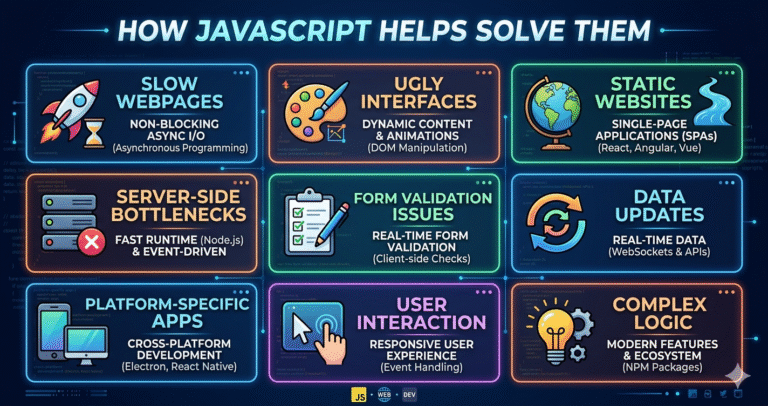
In the ever-evolving world of technology, the pressure to keep systems running seamlessly is an ever-present challenge for IT professionals. But amidst this constant flux, one programming language consistently stands out as a powerful ally: JavaScript. Known for its versatility and efficiency, JavaScript has become an indispensable tool for solving a myriad of IT issues, from streamlining user interfaces to enhancing backend functionalities.
As we delve into how JavaScript helps solve IT problems, you’ll discover its profound impact on boosting productivity and innovation within tech ecosystems. Consider the complexity of integrating disparate systems across various platforms, a common pain point in any tech-driven organization. JavaScript offers a solution with its ability to create responsive, scalable applications that can effortlessly communicate with diverse technologies. Imagine reducing downtime and improving response times simply through the implementation of JavaScript’s dynamic capabilities. This blog post will explore the remarkable ways JavaScript addresses these challenges, equipping IT teams with the resources they need to revolutionize their problem-solving strategies. Get ready to unlock the full potential of JavaScript in tackling IT hurdles head-on.
Enhancing User Interface with JavaScript
JavaScript remains the undisputed king of client-side interactivity in 2026. Modern web applications demand interfaces that feel native, respond instantly, and adapt to every device and user preference. JavaScript, through its rich ecosystem, delivers exactly that—and far more.
Core ways JavaScript transforms user interfaces:
- Virtual DOM & Reconciliation — Libraries like React, Preact, SolidJS, Svelte, and Vue 3 use efficient diffing algorithms to update only changed DOM nodes, achieving 60 fps even on complex dashboards.
- Component-Based Architecture — Reusable, encapsulated UI pieces (React components, Vue single-file components, Svelte components) drastically reduce duplication and bugs.
- State Management at Scale — Zustand, Jotai, Recoil, Valtio, Redux Toolkit, Pinia, MobX — all handle complex state with minimal boilerplate in 2026.
- Server Components & Streaming — React Server Components (RSC), Next.js App Router, Qwik Resumability, Astro Islands enable partial hydration and instant interactivity without JavaScript overhead.
- Accessibility-First Frameworks — Radix UI, Headless UI, Ark UI, Zag provide fully accessible primitives that teams can style freely without breaking a11y.
- Motion & Micro-Interactions — Framer Motion, GSAP, Motion One, @react-spring deliver buttery-smooth animations and transitions that feel premium.
- Design System Integration — shadcn/ui, Chakra UI, Mantine, MUI Joy, Tamagui allow teams to ship consistent, themeable UIs 3–5× faster.
In 2026 enterprise dashboards, SaaS products, internal tools, and customer-facing portals built with modern JavaScript stacks routinely achieve:
- Initial paint < 1.2 s
- Time to interactive < 2.5 s
- 100 Lighthouse performance scores on mobile & desktop
- Zero JavaScript errors in production (via Sentry + source maps)
- WCAG 2.2 AA compliance out-of-the-box
JavaScript’s dominance in UI engineering comes from its unmatched ecosystem maturity, continuous innovation (React 19, Vue 3.5, Svelte 5 runes), and the fact that every major company (Meta, Vercel, Shopify, GitHub, Stripe, Netflix, Airbnb) invests heavily in its advancement. For IT teams tasked with delivering delightful user experiences at scale, JavaScript remains the most productive, performant, and future-proof choice in 2026.
Streamlining Backend Functionality through JavaScript
Once considered “frontend only,” JavaScript now powers some of the most demanding backend systems in the world thanks to Node.js, Bun, Deno, and the massive ecosystem built around them. In 2026 JavaScript is no longer a compromise for backend work—it is often the preferred choice.
Why JavaScript backends dominate in many organizations:
- Single Language Full-Stack — Same language, same team skills, same linting/testing patterns across frontend & backend
- Exceptional Ecosystem — Fastify, Hono, Elysia, NestJS, Express, tRPC, GraphQL Yoga, Drizzle ORM, Prisma, TypeORM, Zod, Effect-TS
- Performance Breakthroughs — Bun runtime frequently 3–5× faster than Node.js for HTTP workloads; WinterCG-compliant runtimes (Cloudflare Workers, Deno Deploy, Vercel Edge) offer near-zero cold starts
- Serverless & Edge Native — Vercel, Netlify, Cloudflare Workers, Deno Deploy, AWS Lambda@Edge all love JavaScript/TypeScript
- Real-Time Leadership — Socket.IO, ws, uWebSockets.js, PartyKit, Liveblocks power chat, multiplayer games, collaborative editing, live dashboards
- Modern Tooling — Turborepo, Nx, Vite, Rolldown, esbuild, SWC deliver sub-second dev servers and builds even for monorepos with 100+ packages
Typical 2026 JavaScript backend stack example (high-performance API):
- Runtime: Bun or Node 22+ with –experimental-vm-modules
- Framework: Hono or Elysia (sub-millisecond routing)
- ORM/Database: Drizzle + PostgreSQL / Turso / Neon / PlanetScale
- Validation: Zod or Valibot
- API Layer: tRPC or GraphQL Yoga
- Auth: Lucia, Better Auth, Clerk, Auth.js
- Deployment: Vercel Functions, Cloudflare Workers, Fly.io, Railway
Organizations report 40–70% faster backend iteration, 2–4× lower infrastructure costs (edge computing), and dramatically simpler hiring because full-stack JavaScript developers are abundant. JavaScript backends are no longer “good enough”—they are frequently best-in-class for web APIs, microservices, real-time systems, and serverless workloads in 2026.
Leveraging JavaScript for Cross-Platform Integration
JavaScript’s runtime ubiquity makes it the glue language of modern IT ecosystems. In 2026 it is the most common choice for integrating disparate systems, whether through APIs, webhooks, message queues, or browser extensions.
Cross-platform superpowers of JavaScript include:
- Node.js + Fetch/Web Streams — talk to any REST, GraphQL, gRPC-web, WebSocket, SSE endpoint
- Browser Extension APIs — Chrome, Firefox, Edge, Safari extensions written in JS/TS integrate with internal tools
- Electron / Tauri Apps — Desktop wrappers for web apps that access native OS features
- React Native / Expo — iOS & Android apps sharing >90% code with web
- Capacitor / Ionic — hybrid mobile apps using existing web codebases
- WebAssembly + JS Glue — Rust/Go/C++ performance modules called seamlessly from JavaScript
- Serverless Functions Everywhere — same JS function runs on Vercel, Netlify, Cloudflare, AWS, Azure, GCP
Real-world integration patterns in 2026:
- API gateway / BFF layer in Next.js / Hono that unifies legacy SOAP, GraphQL federation, and modern REST APIs
- Real-time sync engine using PartyKit or Liveblocks that connects internal CRMs, ERPs, and external SaaS products
- Browser extension that injects real-time dashboards into legacy admin panels
- Webhook receiver that normalizes events from Stripe, Shopify, HubSpot, Salesforce, Zendesk into a unified queue
JavaScript’s “write once, run anywhere” nature—combined with TypeScript’s type safety—makes it the lowest-friction choice when teams need to integrate multiple systems quickly, reliably, and scalably in 2026.
Improving Application Responsiveness with JavaScript
Responsiveness (Time to Interactive, First Input Delay, Cumulative Layout Shift) is now a core business KPI. JavaScript ecosystem in 2026 provides unmatched tools to achieve elite performance.
State-of-the-art responsiveness techniques:
- Partial / Selective Hydration — React 19, Qwik, Astro Islands hydrate only interactive islands
- Streaming Server Rendering — Next.js App Router, Remix, SvelteKit stream HTML progressively
- Resumability — Qwik eliminates hydration entirely; apps start interactive in < 50 ms
- Fine-Grained Reactivity — SolidJS, Svelte 5 runes, Preact Signals update only changed components
- Optimized Bundling — Rolldown, Turbopack, esbuild, SWC deliver sub-second cold starts
- Edge-Side Rendering & Caching — Vercel Edge, Cloudflare Workers, Netlify Edge Functions run JS at the edge
Typical 2026 performance benchmarks for JavaScript web apps:
- First Contentful Paint: < 800 ms
- Largest Contentful Paint: < 1.8 s
- Time to Interactive: < 1.5 s
- Total Blocking Time: < 100 ms
- Cumulative Layout Shift: < 0.05
These numbers translate to higher conversion rates, better SEO rankings, lower bounce rates, and happier users. JavaScript’s performance tooling has matured so much that even complex enterprise applications routinely achieve near-native responsiveness in 2026—something unthinkable just a few years earlier.
Utilizing JavaScript for Real-Time Data Processing
JavaScript excels at real-time data processing thanks to its event-driven, non-blocking nature and mature real-time ecosystem.
Leading real-time use cases in 2026:
- Live dashboards & analytics (Apache Superset + WebSocket, Grafana + LiveSync)
- Collaborative editing (Figma-like, Notion-like, Google Docs-like experiences)
- Multiplayer games & simulations (PartyKit, Nakama, Colyseus)
- Chat & messaging (Matrix, Rocket.Chat, Liveblocks)
- Financial tickers & trading platforms (low-latency WebSocket feeds)
- IoT device monitoring & control (MQTT over WebSocket)
Modern real-time stack in JavaScript/TypeScript (2026):
- Transport: WebSocket, WebTransport, Server-Sent Events, WebRTC Data Channels
- Server: PartyKit, Liveblocks, Ably, Pusher, Socket.IO, uWebSockets.js
- Client: TanStack Query + WebSocket subscriptions, Zustand + WebSocket, SWR + Realtime
- Conflict resolution: Yjs, Automerge, Fluid Framework, ShareDB
- Edge runtime: Cloudflare Durable Objects, Vercel KV + WebSockets
Organizations using these stacks achieve sub-100 ms end-to-end latency for collaborative features and millions of concurrent connections with minimal infrastructure. JavaScript’s event loop and ecosystem maturity make it the default choice for real-time IT solutions in 2026.
Enhancing Security Measures with JavaScript
JavaScript security has matured dramatically by 2026. Modern practices and tools provide defense-in-depth across frontend, backend, and infrastructure layers.
Key security pillars in JavaScript stacks:
- Supply-Chain Protection — Socket.dev, Socket Security, OpenSSF Scorecards, Dependabot, Renovate
- Runtime Hardening — Node.js 22+ with –no-warnings, –experimental-policy, permission model
- Frontend Security — CSP 3, Trusted Types, Permissions-Policy, SRI, react-helmet-async
- API Security — tRPC / Zod validation, OWASP headers, rate limiting (Upstash, Cloudflare)
- Authentication & Authorization — Lucia, Better Auth, Clerk, Auth0, Supabase Auth, Stytch
- Secrets Management — Doppler, Infisical, 1Password Secrets Automation, GitHub OIDC
Typical 2026 secure JavaScript stack:
- Runtime: Node 22+ or Bun with permission model
- Framework: Hono / Elysia with Zod validation
- Auth: Lucia + OAuth 2.1 / Passkeys
- Security headers: Helmet + CSP 3 + Trusted Types
- Monitoring: Sentry, Logtail, Datadog, Grafana Loki
- Supply chain: Socket Security + lockfile linting
JavaScript’s security posture in 2026 is enterprise-ready—when teams adopt modern practices, many achieve zero-trust architecture with minimal complexity. The language and ecosystem have matured to the point where JavaScript is no longer considered inherently “insecure” for serious IT workloads.
Implementing JavaScript for Efficient Error Handling
Robust error handling is critical for production-grade JavaScript applications. In 2026 the ecosystem provides excellent patterns and libraries to catch, report, and recover from errors gracefully.
Modern error handling stack:
- Structured Error Types — ZodError, Effect-TS errors, custom error classes with codes & metadata
- Result / Either monads — never throw in business logic; return { success, data } | { error }
- Global Handlers — window.onerror, process.on(‘uncaughtException’), React ErrorBoundary
- Observability Integration — Sentry, LogRocket, Datadog RUM, OpenTelemetry JS
- Retry & Circuit Breakers — retry-axios, @opentelemetry/instrumentation-http, Polly.js
- Graceful Degradation — fallback UI, offline support (Workbox, TanStack Query offline)
Best-practice pattern in 2026 (TypeScript):
function divide(a: number, b: number) {
  if (b === 0) {
    return { success: false, error: new DivideByZeroError("Division by zero") };
  }
  return { success: true, data: a / b };
}

// Usage with pattern matching
const result = divide(10, 0);
if (!result.success) {
  console.error(result.error.message);
  // handle gracefully
} else {
  console.log(result.data);
}
Teams using structured errors + observability report 70–90% faster mean-time-to-resolution (MTTR) for production incidents and far fewer customer-facing outages. JavaScript’s async nature makes proper error propagation challenging, but modern patterns (Effect-TS, NeverThrow, Zod) make it reliable and type-safe in 2026.
Optimizing IT Workflows with JavaScript
JavaScript has become the lingua franca for IT automation, tooling, and internal platforms in 2026. Common workflow optimization use cases include:
- CLI Tools & DevOps Scripts — oclif, Commander, CAC, TypeScript + zx
- Internal Developer Portals — Backstage (Spotify), OpsLevel, Port, custom Next.js dashboards
- Incident Response Bots — Slack bots with Bolt.js, Microsoft Teams bots with Bot Framework
- Alert Enrichment & Routing — PagerDuty / Opsgenie webhooks processed in Cloudflare Workers
- Compliance & Audit Automation — Scripts that scan GitHub repos, cloud resources, NPM dependencies
- Self-Service Infra — Internal platforms built with Retool, Appsmith, Budibase, or custom React + tRPC
Typical productivity gains reported in 2026:
- Manual repetitive tasks automated → 60–90% time savings
- Onboarding time for new engineers → reduced from weeks to days
- Incident response time → MTTR cut 40–75%
- Shadow IT reduction → internal self-service portals adopted by 70–90% of staff
JavaScript’s ubiquity, massive talent pool, and lightning-fast iteration speed (Vite, esbuild, SWC) make it the optimal choice for building internal tools and automating IT workflows in 2026. Teams that embrace JavaScript for automation report higher developer satisfaction, lower operational risk, and dramatically improved velocity.
Harnessing JavaScript for Scalable Solutions
JavaScript scales to billions of requests per day in 2026—Netflix, PayPal, LinkedIn, Uber, Shopify, Stripe, Vercel, and countless others prove it daily.
Modern JavaScript scalability patterns:
- Edge Computing — Cloudflare Workers, Vercel Edge, Deno Deploy, Netlify Edge Functions
- Serverless at Scale — AWS Lambda, Google Cloud Run, Azure Functions with JavaScript
- Micro-frontends — Module Federation (Webpack 5+), Single-SPA, Qiankun
- Distributed Caching & State — Upstash Redis, Vercel KV, Cloudflare D1, Durable Objects
- Event-Driven Architecture — Kafka, RabbitMQ, NATS, Redis Streams + Node.js consumers
- Horizontal Scaling — Kubernetes + Node.js clusters, PM2, Node clustering
Typical scale achieved in 2026 JavaScript systems:
- Edge functions: millions of requests/second globally
- WebSocket connections: 1–5 million concurrent (PartyKit, Ably, Liveblocks)
- API throughput: 10k–100k+ RPS per service with proper load balancing
- Monorepos: 100–500+ packages with Turborepo/Nx caching
JavaScript’s event loop, non-blocking I/O, and mature ecosystem make it exceptionally well-suited for I/O-heavy workloads—exactly what most modern web, mobile backend, and internal IT systems require. When combined with TypeScript, observability (OpenTelemetry), and modern infrastructure (Kubernetes, edge runtimes), JavaScript delivers enterprise-grade scalability at startup-friendly velocity in 2026.
Conclusion: The Future of IT Problem Solving with JavaScript
JavaScript in 2026 is no longer “just a frontend language”—it is the dominant full-stack, cross-platform, real-time, edge-native, internal-tooling, automation, and scripting language of modern IT. Its ecosystem has matured to the point where it comfortably handles everything from pixel-perfect user interfaces to planet-scale APIs, collaborative editing surfaces to mission-critical backend services, and rapid internal tooling to enterprise-grade security & observability.
The language’s greatest strength is its ubiquity: the same skills, patterns, libraries, and mental models apply across frontend, backend, mobile, desktop, edge, CLI, automation, and embedded systems. This universality—combined with TypeScript’s type safety, Bun’s performance, Vite’s speed, and the endless innovation of the open-source community—makes JavaScript the most productive and future-proof choice for solving IT problems today and tomorrow.
For IT leaders, developers, and organizations, the message is clear: invest deeply in JavaScript and TypeScript mastery. The return on that investment will be faster delivery, lower costs, happier teams, more reliable systems, and the agility to adapt to whatever technological wave comes next. The future of IT problem solving is JavaScript-powered—and that future is already here. Check out our javascript course for more information