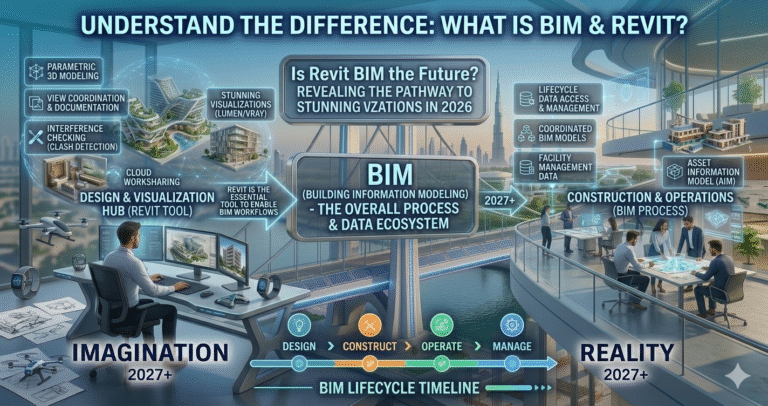
In the dynamic world of architecture, engineering, and construction, adopting cutting-edge technology is not just an advantage—it’s a necessity. Enter BIM (Building Information Modeling) and Revit, two powerhouse tools that are revolutionizing how professionals in these fields conceptualize, design, and execute projects. But what exactly are BIM and Revit, and how do they intertwine to drive innovation in the industry?
If you’re new to these terms or seeking a deeper understanding, you’re in the right place. Imagine a future where architects can collaborate seamlessly with engineers and contractors, ensuring that every aspect of a building’s lifecycle is planned meticulously and executed flawlessly. This isn’t just a utopian dream; it’s the reality that BIM and Revit are making possible today. By integrating sophisticated software technology with comprehensive digital models, these tools facilitate a level of precision and efficiency previously unimaginable. Whether you’re a seasoned professional or a curious novice, unveiling the connection between BIM and Revit could be the key to unlocking new possibilities in your projects. Let’s dive into their fascinating relationship and explore how they are transforming the industry landscape.
The Evolution of Building Information Modeling (BIM)
Building Information Modeling (BIM) has evolved from conceptual origins in the 1970s to a global standard by 2026. Early digital tools focused on 2D drafting; the shift to 3D modeling in the 1980s–1990s laid groundwork, but BIM’s true emergence came in the early 2000s with standards defining it as a process for creating and managing intelligent digital representations of built assets across their lifecycle—from planning through operations.
By the 2010s, governments mandated BIM (e.g., UK Level 2 in 2016), driving adoption for clash detection, cost estimation, and sustainability. In 2026, BIM integrates AI, IoT, and cloud platforms, evolving into “connected BIM” with digital twins for real-time asset monitoring. ISO 19650 standards guide collaborative processes, emphasizing data management and open formats like IFC.
Revit pioneered parametric BIM in 2000, enabling elements to carry rich data (geometry, materials, performance). Today’s BIM extends to 4D (time/scheduling), 5D (cost), 6D (sustainability), and 7D (facility management). Revit 2026 advancements like Accelerated Graphics (GPU/Hydra Tech Preview) for massive models, ReCap Pro Mesh for Scan-to-BIM, and enhanced toposolids support this evolution, reducing rework by 20–30% and enabling predictive analytics. BIM now powers smart cities, net-zero buildings, and resilient infrastructure—transforming AEC from reactive to proactive, data-driven practices.
Understanding the Basics of BIM
BIM is a holistic process creating and managing digital representations of physical/functional building characteristics. Per ISO 19650 and Autodesk, it’s a shared knowledge resource integrating multi-disciplinary data for informed decisions across the lifecycle.
Core basics: intelligent 3D models with parametric elements (walls update across views/schedules); data dimensions (3D geometry + 4D time, 5D cost, 6D sustainability); collaboration via shared models; open standards (IFC) for interoperability. BIM levels range from Level 0 (2D CAD) to Level 3+ (integrated, cloud-based with digital twins).
In 2026, basics include reality capture integration, AI clash detection, and generative design exploring variants. Benefits: reduced errors, better visualization, lifecycle insights. BIM differs from CAD—it’s process-oriented, not just drawings. Tools like Revit enable it, but BIM encompasses methodology, standards, and ecosystem collaboration for efficient, sustainable projects.
Exploring the Features and Capabilities of Revit
Revit, Autodesk’s flagship BIM software, offers parametric modeling, multi-disciplinary tools (architecture, structure, MEP), and cloud integration. Key features: intelligent families/parameters, views/sheets automation, clash detection, schedules/quantities from models.
Revit 2026 highlights: Accelerated Graphics Tech Preview (GPU for smooth large-model navigation), ReCap Pro Mesh plugin (Scan-to-BIM with point clouds/meshes), enhanced toposolids (recessed subdivisions, flexible boundaries), improved coordination models (visibility/IFC linking), Dynamo 3.5/3.6 (autocomplete nodes, performance), flexible compound structures (no core required), and generative design for optimization.
Capabilities extend to energy analysis, rendering (Twinmotion integration), and automation. Revit supports openBIM via IFC export, enabling interoperability. For AEC teams, it streamlines workflows, reduces manual tasks, and provides data-rich models for construction and operations—making it essential for complex projects in 2026.
Key Differences Between BIM and Revit
BIM is the process/methodology; Revit is a software tool enabling it. BIM is holistic—creating/managing data-rich models across lifecycle; Revit is parametric authoring software for 3D intelligent models.
Differences: BIM is platform-agnostic (uses multiple tools like ArchiCAD, Tekla); Revit is Autodesk-specific with built-in BIM features. BIM emphasizes collaboration/standards; Revit provides tools for implementation (families, worksharing). BIM includes 4D–7D dimensions; Revit supports them via integrations.
In 2026, Revit excels in seamless BIM workflows with cloud/AI enhancements, but BIM requires processes beyond software (standards, training). Revit supports BIM but isn’t BIM—it’s a leading enabler, bridging design to execution effectively.
Benefits of Implementing BIM in AEC Projects
BIM delivers clash detection (reducing rework 20–30%), accurate quantities/costs (5D), scheduling (4D), and sustainability analysis (6D). In 2026, AI/generative design optimizes layouts; digital twins enable predictive maintenance.
Collaboration improves via shared models/cloud platforms, cutting RFIs/change orders. Visualization aids stakeholder buy-in; lifecycle data supports operations. Cost/time savings, better quality, sustainability, and compliance are key—essential for AEC efficiency in 2026.
Leveraging Revit for Enhanced Collaboration in AEC
Revit enables real-time worksharing/cloud collaboration via Autodesk Construction Cloud. Linked models/coordination views detect clashes early; Dynamo automates tasks; markup/issue tracking streamlines feedback.
2026 enhancements: better coordination models, IFC support, Twinmotion for visualization. Multi-disciplinary teams (architecture/MEP/structural) work concurrently—reducing silos, accelerating delivery, and improving outcomes in AEC projects.
Real-World Applications of BIM and Revit
BIM/Revit power mega-projects: stadiums use clash detection; hospitals leverage MEP coordination; renovations apply Scan-to-BIM. In 2026, digital twins monitor smart buildings; generative design optimizes sustainable structures.
Applications span design, construction (4D sequencing), operations (facility management), and infrastructure—demonstrating BIM/Revit’s versatility for efficient, innovative AEC delivery.
Overcoming Challenges in Adopting BIM and Revit
Challenges: learning curve, performance in large models, interoperability, resistance to change. Solutions: training, phased adoption, hardware/cloud upgrades (2026 GPU acceleration helps), standards/plugins for legacy data.
ROI from reduced errors/costs overcomes initial investment. With support, teams achieve seamless BIM/Revit integration for long-term gains.
The Future Outlook: Innovations in BIM and Revit
2026 trends: AI for predictive analytics/generative design, digital twins for operations, cloud-first collaboration, IoT integration. Revit evolves with GPU graphics, reality capture, automation—leading to smarter, sustainable buildings.
Future: agentic AI, full lifecycle twins, open ecosystems—positioning BIM/Revit as central to predictive, efficient AEC.
Conclusion: The Synergy Between BIM and Revit
BIM as process and Revit as tool create powerful synergy—enabling precise, collaborative, data-driven AEC. In 2026, with Revit innovations and BIM trends, they drive innovation, sustainability, and efficiency—unlocking transformative potential for the built environment.