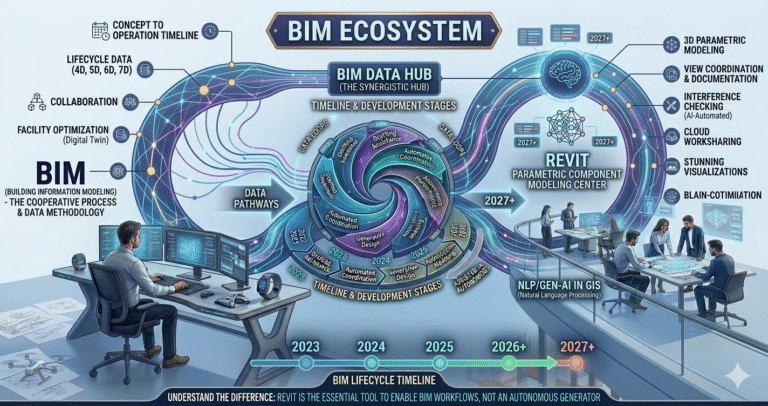
In the ever-evolving world of architecture and construction, staying abreast of the latest technologies is not just a luxury but a necessity. Among these technologies, Building Information Modeling (BIM) and Revit stand out as pivotal tools, often creating a buzz in industry conversations. However, despite their frequent association, they serve quite different purposes.
Imagine navigating a project where clarity is key, yet you’re caught between two seemingly synonymous terms that could determine the success or failure of your design objectives. This is where understanding the distinction becomes crucial. As you delve deeper into the construction sector’s digital transformation, you’ll find that deciphering “what is difference between BIM and Revit” is not merely an academic exercise. It’s about leveraging the right tool at the right time to enhance efficiency, foster collaboration, and ultimately drive innovation. In this blog post, we’re not just exploring definitions and functionalities; we’re unveiling how these two elements complement each other in shaping the future of building design and construction. Prepare for a journey that promises to demystify these concepts, empowering you to make informed decisions that propel your projects to new heights.
Understanding Building Information Modeling (BIM)
Building Information Modeling (BIM) is a holistic process, methodology, and digital framework for creating and managing information about a built asset across its entire lifecycle—from earliest planning through design, construction, operation, maintenance, and eventual decommissioning or repurposing. According to ISO 19650 (the international BIM standard), BIM is defined as the use of a shared digital representation of a built asset to facilitate design, construction, and operation processes to form a reliable basis for decisions.
BIM is not software. It is a way of working that emphasizes:
- Collaboration across disciplines (architecture, engineering, construction, owners, facility managers)
- Data-rich, intelligent 3D models instead of static 2D drawings
- Lifecycle information management (beyond design & construction)
- Open standards (IFC, COBie, ISO 19650) for interoperability
- Levels of maturity (Level 0 → Level 3+ / iBIM / Digital Twin stage)
In 2026, BIM maturity in the United States has advanced significantly. Federal mandates (GSA, DoD, VA), state transportation departments, and large private developers require BIM Level 2+ on most public projects. BIM now routinely includes 4D (scheduling), 5D (cost), 6D (sustainability/energy), 7D (facilities management), and increasingly 8D (health & safety) dimensions. AI and machine learning are enhancing BIM through automated clash detection, generative design, predictive maintenance, and digital twin synchronization. BIM is the overarching philosophy and ecosystem—Revit is just one of many tools that can be used to author BIM-compliant models.
Unpacking the Core Functions of BIM
The core functions of BIM revolve around creating, sharing, and managing structured, trustworthy information throughout an asset’s lifecycle. These functions include:
| Core Function | Description | 2026 Practical Example |
|---|
| 3D Coordination | Clash detection & spatial coordination | Automated weekly federated model checks on hospital projects |
| Data Management | Centralized, version-controlled information repository | Common Data Environment (CDE) on Autodesk Construction Cloud or Procore |
| Simulation & Analysis | Energy, daylight, structural, acoustic, fire, traffic modeling | AI-enhanced energy optimization during schematic design |
| Quantity Takeoff & Cost | Automated, rule-based quantity extraction | 5D integration with Sage 300, ProEst, or Autodesk Quantify |
| Construction Sequencing | 4D visualization & simulation | Navisworks or Synchro 4D linked to Primavera P6 |
| Operations & Maintenance | As-built model handover with asset data | COBie/IFC export to IBM Maximo or Archibus FM systems |
| Digital Twin Enablement | Live data connection to IoT sensors | Real-time HVAC performance monitoring & predictive maintenance |
BIM’s true value emerges when these functions are integrated into a collaborative, standards-driven process—regardless of which authoring tool (Revit, ArchiCAD, Tekla, Bentley, Vectorworks, etc.) is used to create the models.
Introducing Revit: A Comprehensive Overview
Autodesk Revit is a building information modeling software application developed specifically for architects, structural engineers, MEP engineers, and contractors. First released in 2000, Revit pioneered the concept of parametric, relationship-based modeling in the AEC industry. In 2026 Revit remains the most widely adopted BIM authoring tool in the United States, particularly for building projects.
Revit’s core philosophy is “one model, many views” — changes made anywhere (plan, section, 3D view, schedule) propagate everywhere automatically. It supports:
- Architectural design (walls, floors, roofs, stairs, railings)
- Structural modeling (beams, columns, foundations, rebar)
- MEP systems (HVAC, plumbing, electrical, fire protection)
- Construction documentation (plans, sections, elevations, details, schedules)
- Worksharing & cloud collaboration (Autodesk Construction Cloud)
- Interoperability via IFC, DWG, DWF, NWC, Rhino, SketchUp, etc.
Revit 2026 introduced significant enhancements: Accelerated Graphics (GPU/Hydra Tech Preview), ReCap Pro Mesh plugin for Scan-to-BIM, improved toposolids, flexible compound structures, Dynamo 3.6, and tighter integration with Autodesk AI tools (generative design, assistants). Revit is a BIM authoring platform—it enables users to create BIM-compliant models—but it is not BIM itself. BIM is the process and standard; Revit is one of many tools that can be used to implement that process.
Exploring the Features of Revit Software
Revit’s feature set is purpose-built for coordinated, data-rich building design. Standout capabilities in 2026 include:
- Parametric families & shared parameters — intelligent, reusable components
- Global parameters & associative arrays — drive multiple elements from one value
- Worksets & central model — multi-user concurrent editing
- Cloud worksharing — real-time collaboration via ACC
- Generative design — explore massing & structural options
- Revit-to-Robot / Structural Analysis integration
- MEP fabrication parts & service coordination
- Reality capture support (point clouds via ReCap)
- AI Assistants (Arcade, expression generation)
- Performance boosts — 2026 GPU acceleration, faster model regeneration
These features make Revit exceptionally strong for detailed building design, documentation, and coordination—particularly in vertical construction (commercial, healthcare, education, residential towers). Its tight integration with the Autodesk ecosystem (Civil 3D, Navisworks, BIM 360/ACC, Insight, Forma) provides a seamless end-to-end workflow for U.S. firms that standardize on Autodesk products.
Key Differences Between BIM and Revit
Understanding the fundamental distinction is critical:
| Aspect | BIM | Revit |
|---|
| Definition | Process, methodology, and standards for digital information management | Software application for authoring BIM models |
| Scope | Lifecycle-wide (planning → operations → decommissioning) | Primarily design & construction authoring |
| Ownership | Industry / standards bodies (ISO, buildingSMART, AGC, AIA) | Autodesk (proprietary) |
| Interoperability | Requires open standards (IFC, COBie) | Supports IFC export/import but is proprietary format (.rvt) |
| Tools | Can use Revit, ArchiCAD, Tekla, Bentley, Vectorworks, Allplan, etc. | Revit is the tool itself |
| Maturity Level | Level 0–3+ / iBIM / Digital Twin | Software version (2026, 2027, etc.) |
| Purpose | Deliver reliable, shared information for decision-making | Create intelligent, parametric models |
In short: BIM is the goal and the way of working; Revit is one of the most popular vehicles for achieving that goal in building projects.
Use Cases: When to Choose BIM Over Revit
BIM is the appropriate choice when:
- Project requires multi-platform collaboration (architect uses Revit, structural uses Tekla, MEP uses AutoCAD MEP)
- OpenBIM / IFC deliverables are contractually required
- Focus is on facility management handover (COBie, digital twin integration)
- Project involves infrastructure (bridges, tunnels, rail) where Revit is not optimal
- Owner demands vendor-neutral data and long-term model ownership
- Goal is lifecycle management, not just design & construction
Revit is usually the preferred authoring tool when:
- Project is a vertical building (office, hospital, school, residential)
- Team is already standardized on Autodesk ecosystem
- Need fast, coordinated documentation production
- Parametric architectural / MEP / structural design is central
- Project timeline demands rapid iteration and visualization
Most successful U.S. projects in 2026 use Revit as the primary authoring tool while adhering to BIM processes and standards.
Harnessing the Power of Revit Alongside BIM
Revit and BIM are not mutually exclusive—they are complementary. Best practice is to use Revit to create high-quality, intelligent models that comply with BIM execution plans (BEP) and information delivery manuals (EIR). Key strategies:
- Model with LOD (Level of Development) requirements in mind
- Use shared parameters & project parameters consistently
- Export clean IFC files with proper property sets
- Maintain naming conventions & classification standards
- Regularly federate & clash-detect with Navisworks or ACC Model Coordination
- Publish COBie data for FM handover
When Revit models are created with BIM principles in mind, they become valuable assets throughout the project lifecycle—enabling better coordination, fewer RFIs, faster approvals, and richer facility management data.
Maximizing Collaboration Through BIM and Revit Integration
Collaboration is BIM’s greatest promise, and Revit provides excellent tools to realize it:
- Worksharing (central model + local copies)
- Cloud worksharing via Autodesk Construction Cloud
- Linked models (architectural, structural, MEP federated)
- Coordination Review & Copy/Monitor tools
- Model Coordination module in ACC (automated clash detection)
- BIM 360/ACC Issues & Markup tools
- Revit Add-ins (Dynamo, pyRevit, CTC tools) for automation
In 2026, U.S. firms increasingly use ACC as the Common Data Environment, with Revit models synced in real time, enabling distributed teams to collaborate seamlessly across time zones while maintaining version control and audit trails.
Industry Impact: How BIM and Revit are Shaping Construction
BIM adoption in the U.S. has reached maturity in many sectors by 2026. Revit dominates building design authoring, while BIM processes drive:
- 30–50% reduction in RFIs and change orders
- 10–20% faster project delivery on average
- Significant waste reduction through better coordination
- Improved safety planning (4D, 5D, constructibility reviews)
- Enhanced sustainability (early energy & carbon analysis)
- Digital twin foundations for smart buildings & cities
Major U.S. projects (e.g., California High-Speed Rail, major hospital expansions, data centers, stadium renovations) now mandate BIM Level 2+ with Revit as the primary authoring tool. The combination has become a de facto standard for high-value, complex vertical construction—driving quality, predictability, and long-term asset value.
Conclusion: Leveraging BIM and Revit for Future Projects
BIM is the process, the philosophy, and the standard. Revit is one of the most powerful and widely adopted tools for implementing that process in building projects. Understanding the difference—and the symbiotic relationship between them—is essential for any modern AEC professional. In 2026, the most successful teams use Revit to author rich, coordinated models that fully support BIM requirements—delivering better outcomes, fewer surprises, and greater value throughout the project lifecycle. Embrace both: the vision of BIM and the precision of Revit. Together, they are transforming construction into a more collaborative, efficient, and sustainable industry. For More Detail You can check out our Revit BIM Course